
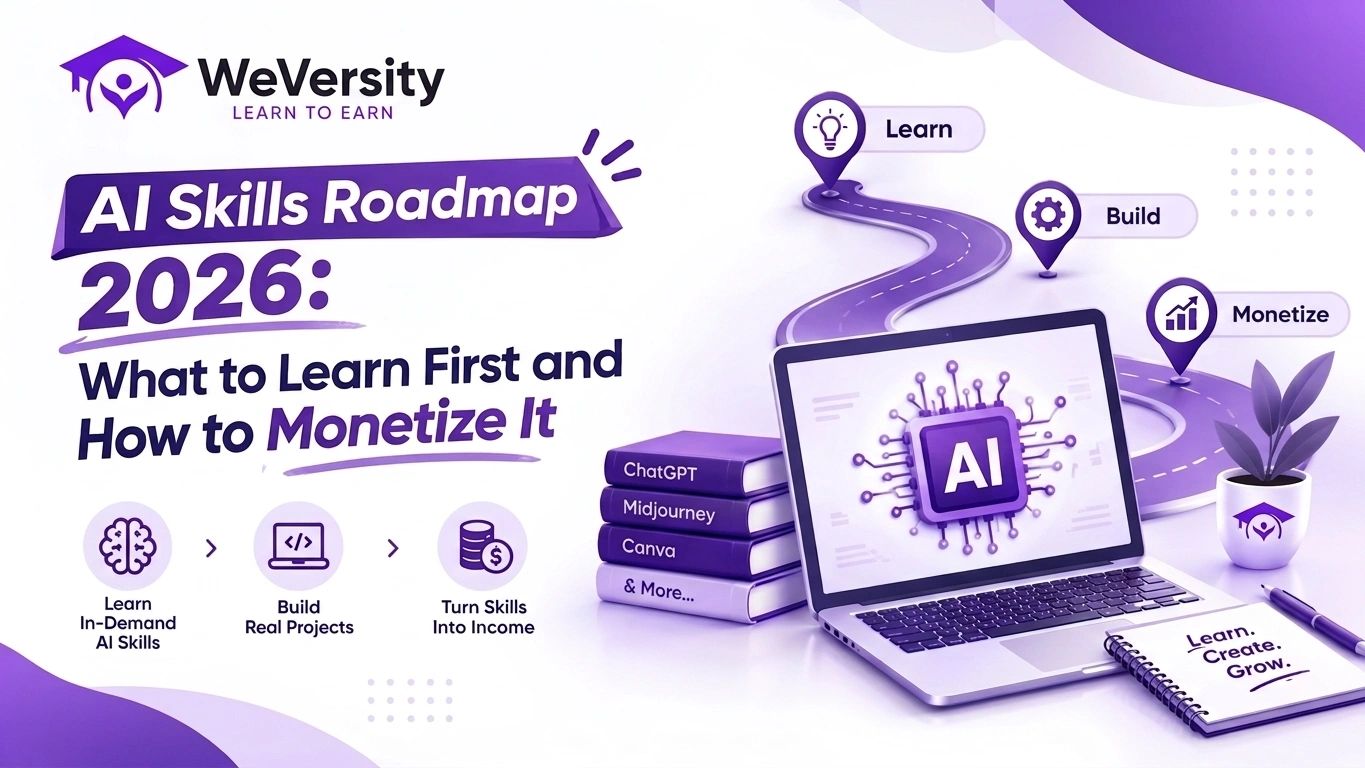
The artificial intelligence field is evolving rapidly from simple prompt generation to structured context design, automated software building, and multi-agent workflows. While basic chat interactions remain useful for daily writing and brainstorming, professional growth and client opportunities increasingly favor individuals who can manage technical workflows, organize system data, and build connected tools.
This roadmap outlines a balanced, educational path to help beginners step into practical AI skills and understand real-world earning opportunities without hype.
Direct Answer Capsule: The AI skills roadmap 2026 is a three-level learning path designed to move learners from basic tool usage to technical monetization. Level 1 covers context engineering (giving AI exact guidelines and clean data). Level 2 introduces Vibe Coding (building web applications using plain-English prompts). Level 3 covers Agentic Systems (setting up automated AI assistants that talk to external apps). Learners turn these skills into income by setting up business knowledge bases, building simple client web tools, and creating automated workflows.
How AI Tool Usage Is Shifting
In the early stages of generative AI, many users relied on simple, short questions typed into a single search box. While these simple prompts are still helpful for quick answers, they can sometimes lead to vague or inaccurate results because the AI lacks proper background context.
Today, professional workflows focus on providing complete instructions and clean reference materials up front. The Stanford HAI AI Index Report documents that organizations are rapidly increasing enterprise integration of technical AI tools, shifting reliance from casual chat usage toward systematic workplace workflows and API-driven task execution.
Understanding Key Terms in Plain English
To help you navigate this space smoothly, here are four important technical concepts explained simply:
- Context Engineering: The practice of giving an AI model precise instructions, background facts, and formatted rules so it generates accurate, reliable outputs every time.
- Vibe Coding: Building software by describing what you want in everyday language, while an AI assistant generates the underlying code for you.
- Multi-Agent Coordination: Linking multiple specialized AI helpers together—where one researches, another writes, and a third checks for errors—to complete complex jobs.
- Database Wiring & MCP: Database wiring means connecting an AI model to live business storage so it can read company data safely. Model Context Protocol (MCP) is the standard plug-and-play rule system that lets the AI communicate securely with external software apps like Slack or Google Sheets.
The 3-Tier AI Skill Stack
Mastering practical AI execution works best when you follow a step-by-step path. Each layer builds upon the previous one, opening up broader learning and service possibilities.
LEVEL 3: AGENTIC AI & AUTONOMOUS SYSTEMS
Tools: LangGraph, CrewAI, MCP Servers
Services: Business Process Automation
LEVEL 2: VIBE CODING & INTENT ENGINEERING
Tools: Cursor, Windsurf, Claude Code
Services: Simple Client Apps & Internal Dashboards
LEVEL 1: ADVANCED CONTEXT ENGINEERING
Tools: Anthropic Claude, System Guidelines
Services: Knowledge Base Setup & SOP Systems
Level 1: Advanced Context Engineering
Level 1 focuses on organizing information, writing clear system guidelines, and preventing inaccurate AI answers.
- Core Skills: Managing reference documents, designing standardized templates, and organizing clean data inputs.
- Primary Tools: Advanced reasoning models (such as Anthropic Claude models and OpenAI o-series reasoning models).
- Practical Training: Learn how to design system prompts and manage complex business facts through Mastering Claude AI: Advanced Prompting and Context Management.
Level 2: Vibe Coding and Intent-Based Building
Software creation no longer requires memorizing every line of code syntax. Beginners can use clear, plain-English instructions to guide automated development software.
- Core Skills: Describing application logic, reviewing generated layouts, testing features, and connecting basic databases.
- Primary Tools: Cursor, Windsurf, Claude Code, and GitHub Copilot.
- Practical Training: Build full web tools using plain-English directions by following Vibe Coding and Intent-Based Engineering.
Level 3: Agentic Systems and Connected Protocols
Level 3 centers on setting up autonomous AI assistants that break down big projects, call external tools, and auto-correct their own mistakes.
- Core Skills: Managing multi-agent teams, connecting external tools, and setting up communication rules through the Model Context Protocol (MCP).
- Primary Tools: LangGraph, CrewAI, AutoGen, and dedicated MCP servers.
- Practical Training: Explore how self-directing systems handle real workflows in What is Agentic AI and Why It Is the Future.
Practical Earning Estimates and Pathways
Acquiring technical skills allows you to offer useful services to businesses looking to save time. Below are sample project rate illustrations based on freelance platform listings (such as the Upwork Skill & Rate Benchmarks as of 2025/2026). These figures serve as illustrative project scopes rather than guaranteed income:
Skill Level
Deliverable Product or Service
Primary Client Channel
Sample Project Rate Scope*
Level 1 (Context)
Automated SOP Systems & Knowledge Base Setup
Local Business Consulting, Freelance Platforms
$500 – $1,500 per project
Level 2 (Vibe Coding)
Simple Web Apps & Internal Dashboards
Freelance Platforms, Direct Founder Outreach
$1,500 – $4,000 per build
Level 3 (Agentic Systems)
Multi-Agent Business Automation Workflows
Corporate Retainers, B2B Integration Projects
$3,000 – $10,000+ per integration
*Scope & Methodology Note: Pricing estimates are compiled from project budget distributions for AI automation and web development listings on Upwork and Fiverr. Actual earning rates vary substantially depending on developer experience, scope complexity, client market location, and technical validation.
Demonstrating Practical Proof
When offering services to clients, a public portfolio can help demonstrate practical skills and build client trust. Showcasing live project samples, short video walkthroughs, and step-by-step case studies can provide stronger evidence of your abilities than basic resume claims alone.

Primary Tool Directory
Staying organized means selecting the right tool for each project phase:
- Reasoning and Analysis Engines: Anthropic Claude (Sonnet family), OpenAI (o-series models).
- Plain-English Coding Tools: Cursor, Windsurf, Claude Code.
- Automation & Connection Frameworks: Model Context Protocol (MCP), Make.com, LangChain.
12-Week Execution Timeline
This structured schedule offers a realistic timeline for beginners balancing study with hands-on practice:
[Weeks 1-3] Learn Context Design, Clear Guidelines & Formatted Outputs
|
[Weeks 4-7] Practice Vibe Coding, Simple Page Layouts & Data Connections
|
[Weeks 8-10] Explore Connected AI Agents & Simple MCP Tools
|
[Weeks 11-12] Build a Public Portfolio Showcase & Begin Client Outreach
Explore the WeVersity Learning Cluster
Build on your AI and technical skills with these practical WeVersity resources covering AI automation, coding, freelancing, and modern technical workflows. These guides can help you move from learning the concepts to applying them in real-world projects and career opportunities.
- How to Learn High-Demand Tech Skills for Free: A Practical 2026 Blueprint
- Coding Classes Online: Your Complete Guide to Learning to Code From Anywhere in 2026
- From Zero to $1,000/Month: The Realistic Guide to Landing Your First Freelance Clients in 2026
- Free Digital Skills and Virtual Internships: The Complete Career Blueprint
- 10 Best AI Side Hustles for Students in 2026 to Earn From Home
Ready to Start Your AI Journey?
Building high-value AI skills doesn't require expensive university tuition or years of coding experience, just a structured roadmap and hands-on practice. At WeVersity, our mission is to make job-ready digital training completely open and accessible to everyone. Browse our free step-by-step courses, build your real-world portfolio, and start unlocking global freelancing opportunities today.