
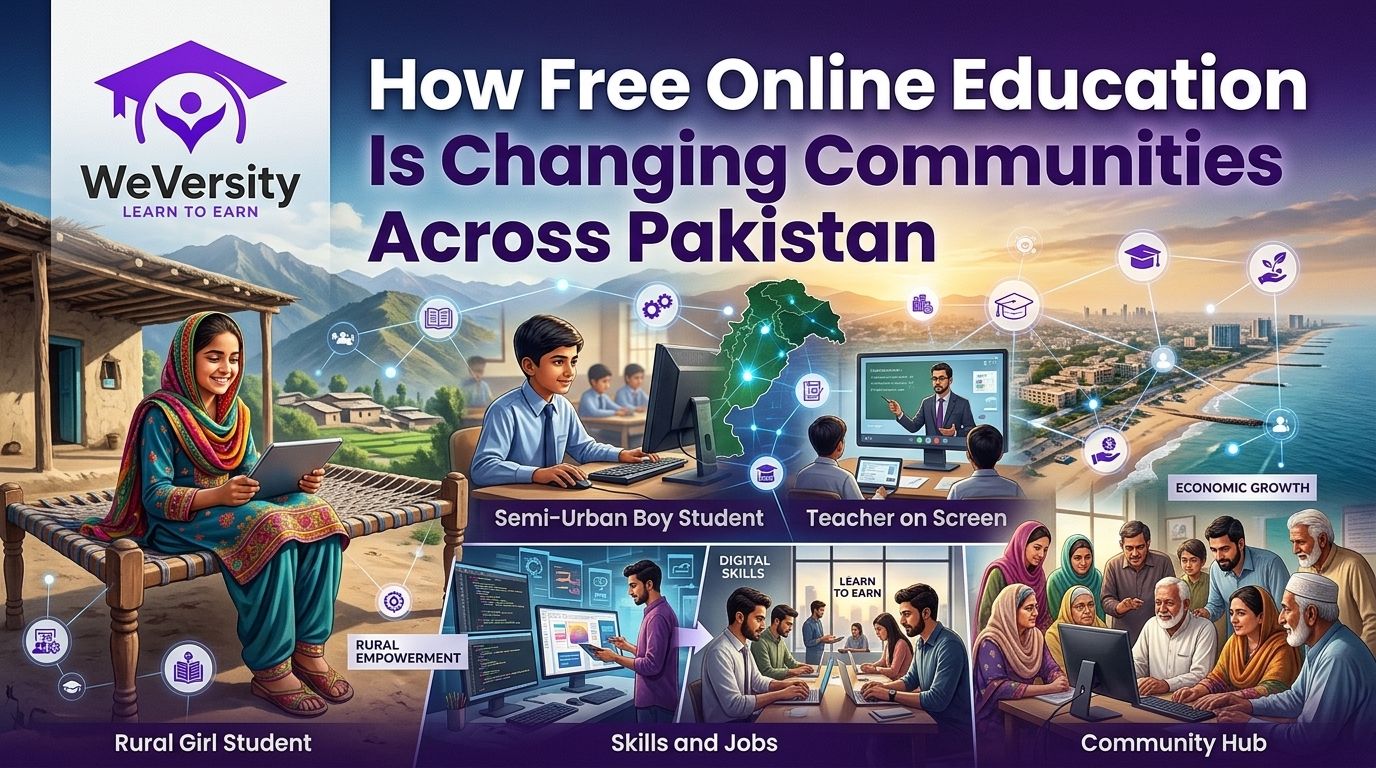
Free online education is giving Pakistanis who were left out of classrooms a second route to learning and paid work. The clearest proof is income: Pakistani freelancers sent home $856.3 million between July 2025 and March 2026, 51% more than a year earlier, according to the government's Pakistan Economic Survey 2025/26. Much of that work begins with a free course on a phone.
This guide shows where the impact of free online education in Pakistan is strongest, who it reaches, what still holds it back, and how a learner can turn a free course into income.
The Impact of Free Online Education in Pakistan at a Glance
Indicator
Latest figure
Source
In short, the need is large, phones are already in millions of hands, and free skills training is now showing up in national income figures.
Why Pakistan Needs Free Online Education: The Learning Gap by Province
Pakistan has the second highest number of out of school children in the world, according to UNICEF. The gap is far wider in some provinces than in others.
Province or territory
Children aged 5 to 16 out of school
Share of the age group
Balochistan
3.5 million
Nearly 69%
Sindh
7.4 million
44%
Khyber Pakhtunkhwa
4.5 million
34%
Punjab
9.7 million
27%
Islamabad Capital Territory
About 0.09 million
15%
Source: UNICEF Pakistan
Children who do attend school often struggle too. In 2019 the World Bank estimated that 75% of Pakistani children could not read and understand a simple text by age 10, against a South Asia average of 58%. Among people aged 10 and above, the 2023 census recorded a literacy rate of 60.65%.
Building schools and training teachers for 25 million children will take decades. Free online courses cannot replace a school, but they can reach people today: a teenager in Balochistan who left school early, a graduate in Sindh with a degree but no job skills, or a mother in Punjab who cannot travel to a training centre.
Free Online Learning Platforms Changing Education in Pakistan
Online learning in Pakistan did not begin with apps. It builds on almost 50 years of distance education, and it grew fast when schools closed during the 2020 pandemic.
Platform or programme
Started
Run by
What learners get
Allama Iqbal Open University
1974
Federal public university
Distance degrees through 44 regional campuses
Virtual University of Pakistan
2002
Federal public university
Online degrees and free recorded lectures
2018
Ministry of IT and Telecom through Ignite, delivered by the Virtual University
Free courses in freelancing, digital marketing, graphic design, SEO, WordPress and ecommerce
HEC and Coursera partnership
2018
Higher Education Commission
Free university courses for enrolled students
2020
Ministry of Federal Education and Professional Training
School lessons on TV, YouTube and mobile apps
NAVTTC skills programmes
Ongoing
National Vocational and Technical Training Commission
Free technical and IT training
Sources for founding dates: Online learning in Pakistan (Wikipedia), DigiSkills.pk
Global platforms such as Khan Academy, Coursera and YouTube fill topics that local programmes do not cover. The local programmes add something global ones cannot: teaching in Urdu, Pakistani examples and payment advice that works here.
How Free Online Education Is Changing Communities Across Pakistan
The change shows up in three places: household income, women's access to work, and rural schools linked to better teaching.
More household income through freelancing
Income is the impact that can be measured most clearly. Between July 2025 and March 2026, according to the Pakistan Economic Survey:
- Freelancers sent home $856.3 million, up from $567.5 million a year earlier.
- Pakistan's ICT exports reached $3.38 billion, a rise of 19.7%.
- DigiSkills reports that freelancers it trained earned $1.65 billion. This is the programme's own estimate of total earnings, so it is higher than the official remittance figure.
In a small town, one steady dollar income can pay a younger sibling's school fees or start a family shop. The earner does not have to move to Karachi, Lahore or abroad to find work.
Women learning and earning from home
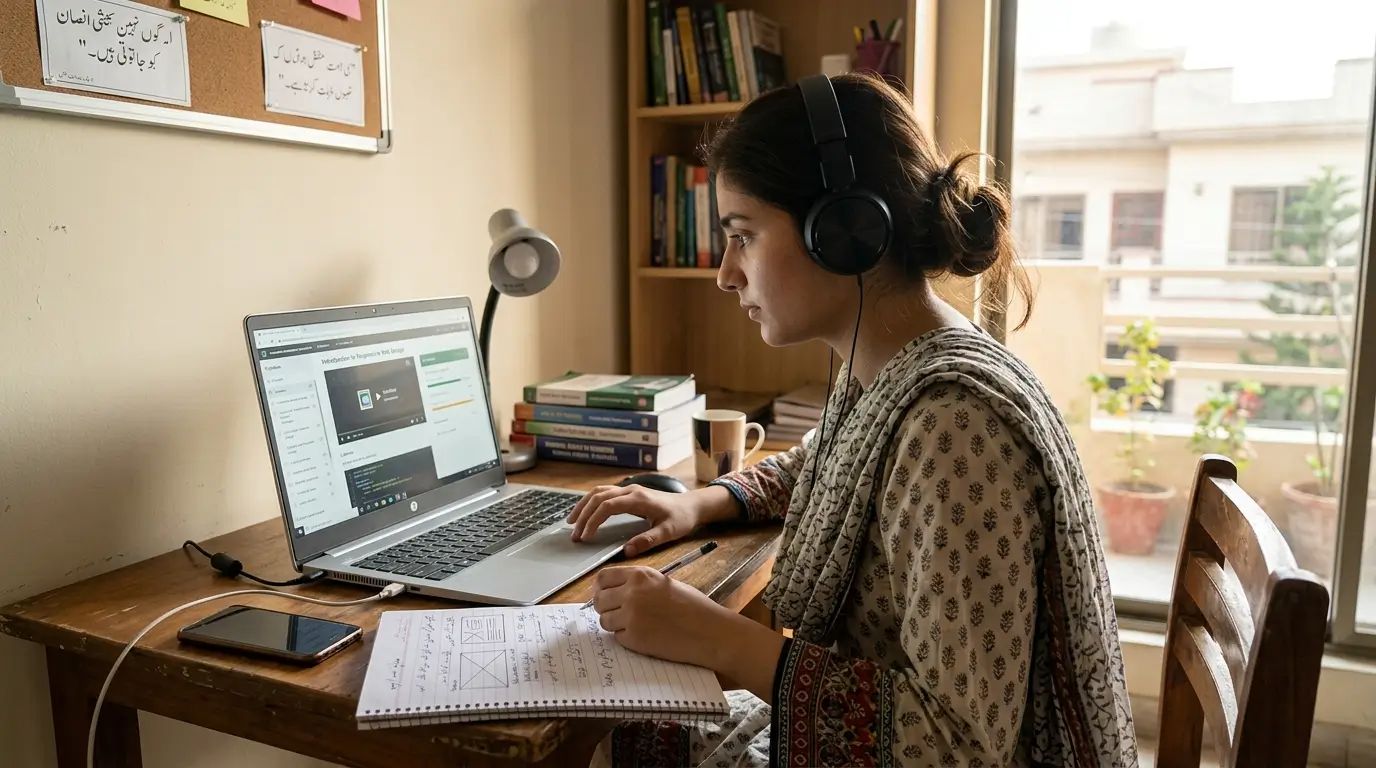
Travel, safety and family duties keep many women out of training centres. Online courses remove that barrier. The GSMA Mobile Gender Gap Report 2025 found that 45% of Pakistani women used mobile internet in 2024, up from 33% a year before, and the gender gap narrowed from 38% to 25% (Profit). About 30% of DigiSkills trainees are women, and the government reports more than 240,000 women trained in digital skills during the same nine months.
WeVersity learner story (editor to add): one verified learner, with consent: name, town, skill learned, time to first payment, and what the income changed at home. A real story here is the strongest experience signal on this page.
Rural schools connected to the wider world
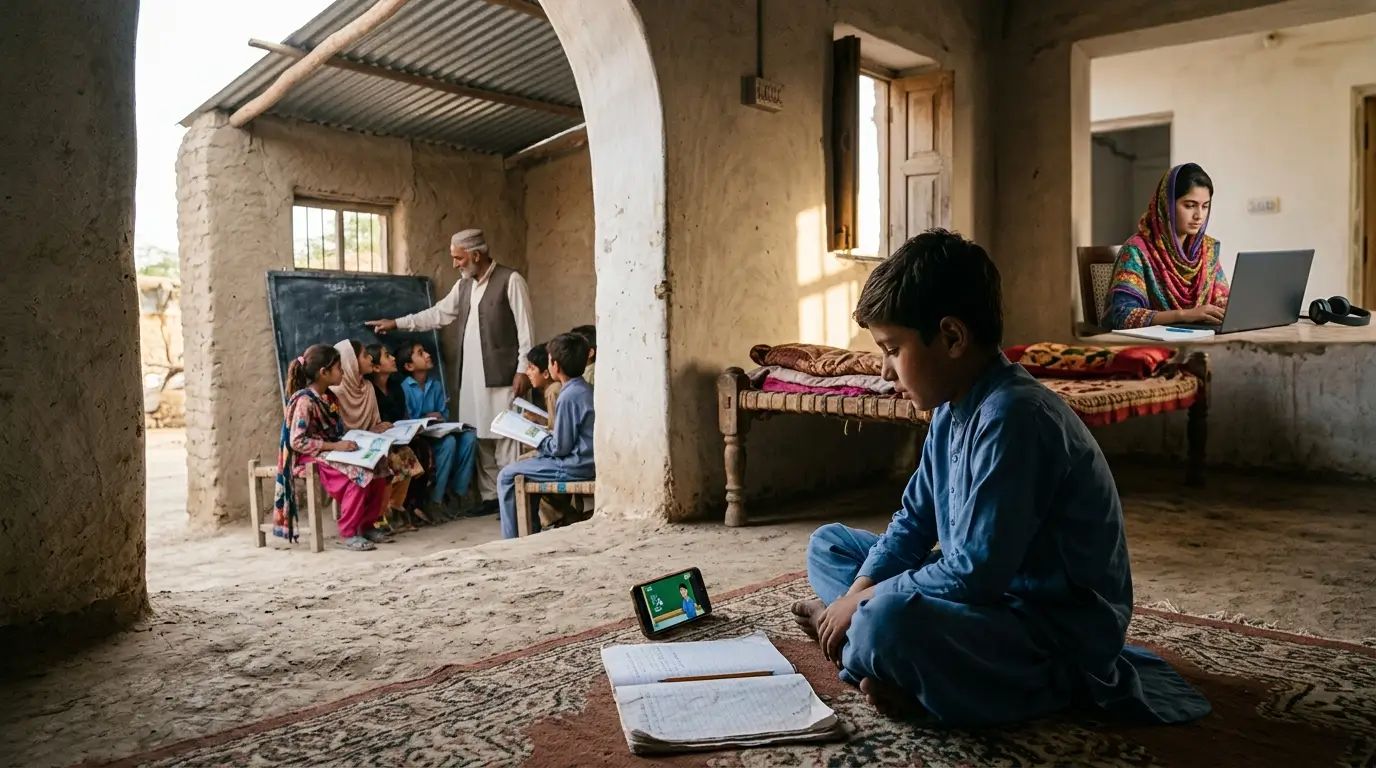
A documented example comes from Chak 5 Faiz, a village about 25 km from Multan. In a pilot that began in December 2015, the Internet Society and COMSATS Internet Services connected the unused computer lab of the Government Girls High School with a 10 Mbps link. Tele Taleem then ran three months of online English, maths and science lessons for 40 girls in grade six. School records showed better grades and attendance, and the same wireless tower brought internet to 25 nearby homes and a local polytechnic.
The same pattern appeared nationally during the 2020 school closures. The World Bank reports that TeleSchool reached an estimated six million children each week. In a Gallup Pakistan survey, 77% of respondents were satisfied, and rural families were more satisfied than urban ones.
Challenges Limiting Online Education in Pakistan, and Practical Fixes
Free courses only help people who can reach them and finish them. These are the main barriers and what is working against each one.
Challenge
Evidence
What helps
Limited internet reach
117 million users, 45.6% of the population (DataReportal)
Lessons that download for offline viewing, low data video, shared community hubs
Women's access
Women are 25% less likely than men to use mobile internet (GSMA via Profit)
Women only groups, female mentors, skills that can be done from home
Shared or basic phones
Many families share one handset
Short lessons built for small screens, with audio and text versions
Language
Most quality courses are in English
Teaching in Urdu and regional languages
Dropping out
Free courses are easy to start and easy to quit
Mentors, weekly goals and peer groups
From skill to client
A certificate alone rarely brings paid work
Lessons on pricing, proposals and handling clients
Subscription numbers can mislead. Official data counts 161 million broadband subscriptions, but many people hold more than one SIM, so far fewer people are actually online.
How to Turn Free Online Education Into Income in 5 Steps
Most articles on this topic list platforms and stop. Learners need the next part: how to get from a free course to a first payment.
- Choose one skill that clients pay for. Good starting points are graphic design, video editing, digital marketing, web design, content writing, virtual assistance and AI tools for business.
- Pick a free course that teaches earning, not only theory. Check the syllabus for lessons on building a portfolio, setting prices and writing proposals.
- Build three to five portfolio samples. Make real work for a friend, a local shop or a mosque committee, and save the results.
- Find your first client. Create profiles on Fiverr, Upwork or LinkedIn, or offer your service to local businesses. Set up a way to receive payment, such as Payoneer or a bank account that accepts foreign transfers.
- Stay with a mentor or community. Questions get answered faster, and learners with support are far less likely to give up halfway.
WeVersity courses follow this path: every free course ends with a simple business plan for earning from the skill. Start a free course at weversity.org.
What Comes Next for Online Learning in Pakistan
Three shifts will decide how far this impact spreads:
- AI skills. Clients increasingly want people who can use AI tools to write, design and analyse faster. Courses that teach these tools in plain Urdu will matter more each year.
- Local language teaching. Learners who study in the language they think in are more likely to finish, and Urdu, Sindhi and Pashto content is still scarce.
- Community learning hubs. Schools, mosques, madrasas and community centres can share one good connection and a few devices so a whole neighbourhood learns together, as Chak 5 Faiz showed. The Pakistan Digital Authority, set up in 2025, is tasked with widening this kind of access.
The evidence so far is clear: when free learning reaches people and teaches them how to earn, the benefit spreads from one learner to a whole household, and from households to the community.