

Skill centers bring digital education to underserved areas by giving people three things they rarely have at home: a working computer, a stable connection, and a trained person to guide them. In Pakistan, the top reason people who know about the internet still don't use it is a lack of literacy and digital skills, with phone cost close behind, according to the GSMA State of Mobile Internet Connectivity 2026. A local skill center tackles both in one room. That is the core idea behind skill centers digital education: bring the lab, the connection, and the mentor to the learner.
At a glance
- Only 46% of rural adults in Pakistan own a phone that can access the internet, compared with 62% in cities.
- Skill centers share devices, so learners don't need to buy a smartphone or laptop first.
- Face-to-face guidance helps beginners finish courses they would quit alone.
- The best centers link training to income through freelancing, internships, and local jobs.
What Is a Skill Center? A Plain English Definition
A skill center is a local room or building with computers, the internet, and a trained facilitator, where people learn practical digital skills and earn a certificate. The International Telecommunication Union runs a similar model called Digital Transformation Centres, which train mostly rural and underserved citizens who start with little or no digital knowledge.
What every skill center needs
- Computers or tablets, ideally one per learner during class
- Stable internet, with UPS, generator, or solar backup for power cuts
- A trained facilitator who answers questions face to face
- A structured curriculum built around real projects
- Certificates that employers can verify online
Skill center, online course, or traditional institute?
Feature
Online course alone
Skill center
Traditional institute
Device provided
No
Yes
Yes
Live help
Rarely
Every session
Yes
Typical cost to learner
Free to low
Free to low
Often high fees
Location
Anywhere with data
Near home
Mostly in cities
Best for
Confident users with a phone or laptop
Beginners without devices
Learners who can travel and pay
Why Underserved Areas Still Miss Out on Digital Education (2026 Data)
Network coverage is no longer the main problem. Devices and skills are. About 140 million people in Pakistan live where mobile broadband reaches but still don't use mobile internet, one of the largest usage gaps in the world (GSMA 2026).
The device gap between cities and villages
Adults in Pakistan (2025)
Urban
Rural
Own a mobile phone.
85%
78%
Own an internet-enabled phone
62%
46%
Use mobile internet
65%
50%
Use it daily.
59%
42%
Use it for 3 or more activities daily.
37%
25%
Source: GSMA Consumer Survey 2025, published in the GSMA State of Mobile Internet Connectivity 2026, pages 40 and 69.
Skills matter more than speed
Among Pakistanis who know about mobile internet but don't use it, literacy and digital skills rank as the top barrier in both cities and villages. That makes digital literacy in rural Pakistan the first problem to solve. Among those who are online, only 31% have ever used mobile internet for education or learning.
Women face extra barriers.
Pakistan cut its mobile internet gender gap from 25% to 8% in one year. Still, only 41% of women own an internet-enabled phone, compared with 62% of men, and 28% of women users go online only through someone else's device. For women, social norms rank second after skills.
Phones are getting more expensive.
The GSMA expects entry-level handset prices to rise sharply because AI demand has pushed memory costs up. Across low- and middle-income countries, a basic internet-enabled handset already costs 44% of monthly income for the poorest 20% of people.
6 Ways Skill Centers Bring Digital Education to Underserved Areas
Each method below removes one barrier to digital education in underserved areas shown in the data above.
- They put a computer within walking distance. A learner can start without buying a phone or laptop, which matters when fewer than half of rural adults own an internet-enabled phone.
- They give live, face-to-face help. GSMA surveys list a lack of support while learning as a real reason people give up. A facilitator in the room fixes a stuck lesson in minutes.
- They offer a safe, nearby space for women. The GSMA recommends using women to reach women, such as female trainers and role models. Women-only batches and female facilitators follow that advice directly.
- They teach in Urdu and local languages. Most quality content is in English. Explaining concepts in a learner's own language removes a hidden barrier the GSMA calls relevance.
- They turn learning into proof. Learners leave with a verifiable certificate and portfolio projects that clients and employers can check.
- They connect training to income. According to the ILO, cited by the ITU, 90% of jobs will require some digital skills by 2030, and the ITU and ILO Digital Skills Campaign aims to equip 25 million young people with job skills by then. Good centers guide learners toward freelancing, internships, and local jobs, not just course completion.
Skill Centers Digital Education Programs Working in Pakistan and Beyond
Large programs prove that free digital skills training works at scale. Most of them, however, open in batches or select learners through entrance tests, so many applicants wait or miss out. The table was checked in November 2026.
Program
Run by
Format
How learners get in
Reported scale
Ministry of IT and Telecom, Ignite, Virtual University
Online, weekly lessons on an LMS
Batch enrollment is up to two courses; Batch 03 offered 300,000 seats on a first-come, first-served basis.
5.5 million+ enrollments since 2018; 18 courses
Saylani Welfare International Trust
Classroom and project-based
Entrance test: over 10,000 sat one Karachi test in February 2025
200,000+ trained since 2013; 80+ courses
Alkhidmat Foundation
Classroom at IT centers
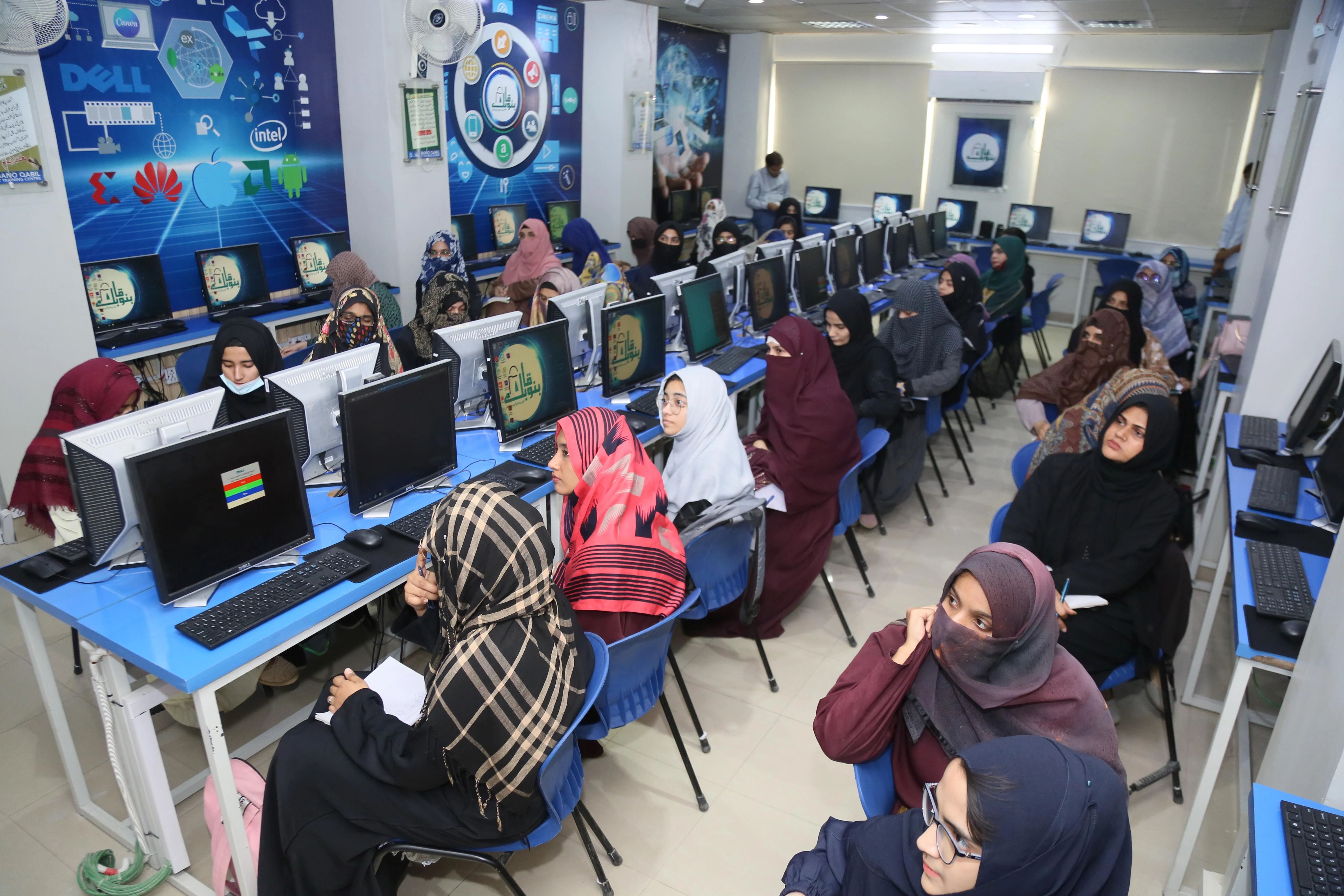
Aptitude test; 100,000 sat the Bano Qabil 4.0 test
48,000+ graduates; 50+ centers; 28 courses
ITU with Cisco
Basic and intermediate training through national institutions
Targets rural and underserved citizens
450,000+ trained, 54% women
WeVersity, a US 501(c)(3) nonprofit
Live online classes plus local computer labs
Open online registration
5 registered centers in Pakistan and the US
If one program doesn't fit your timing or city, another may.
Inside a WeVersity Skill Center: A Firsthand Look from Faisalabad
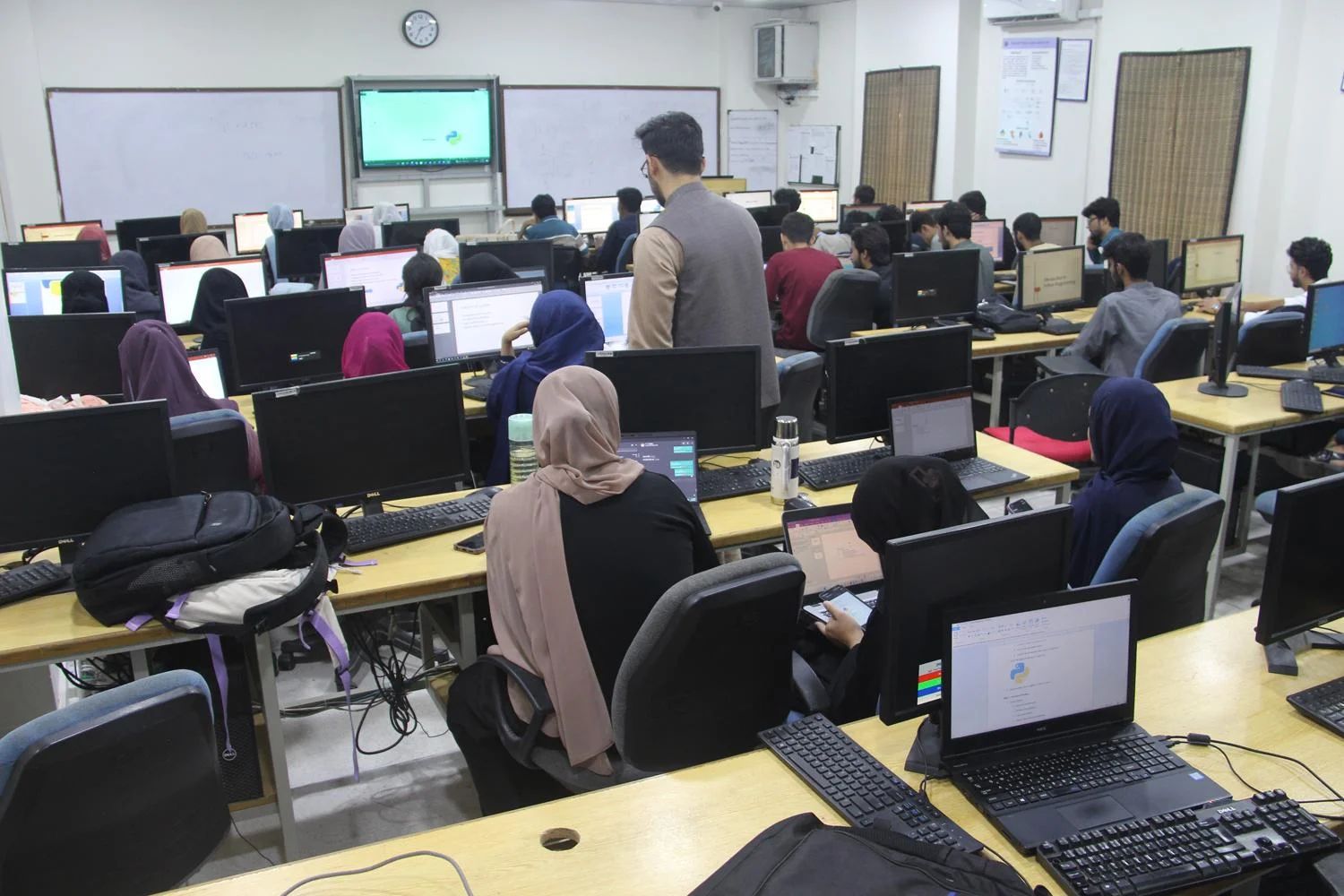
Three of WeVersity's registered partner institutes are in Faisalabad, offering web development, graphic design, and Python training in local computer labs:
- Muhammad Kishwar Ullah Khan Institute of Information Technology: Monday to Saturday, 9 AM to 5 PM, 50 to 100 students
- Faisalabad Bright Future Skills Hub: four days a week, 10 to 25 students
- Zainovate Skill Center: two days a week, 10 to 25 students
Learners follow WeVersity's live online curriculum while a local facilitator guides them in the lab. Every certificate carries a QR code that employers can check on the certificate verification page. Learners in Faisalabad can register as a student online and ask to join one of these labs.
What Skills Do Learners Gain at Digital Skill Centers in Pakistan?
Most centers start with basic digital literacy, then move to skills clients pay for.
Skill
What learners practice
Common earning path
Web development
Building and fixing websites
Freelance projects, agency jobs
Graphic design
Logos, social posts, print layouts
Freelance gigs, local businesses
Digital marketing
Ads, SEO, content calendars
Managing pages for shops and brands
Online selling
Shopify stores, product listings
Running a store or supporting sellers
Python and data
Scripts, spreadsheets, basic analysis
Data entry upgrades, junior roles
Browse current tracks on the WeVersity courses page.
Can Madrasas, Mosques, and Community Centers Become Skill Centers?
Yes. Any trusted space with a quiet room, power backup, and internet can become one of the community digital learning centers families already rely on, using a few tablets or computers and an online curriculum. Trust matters: the GSMA recommends promoting socially accepted uses of the internet, such as children's education and family income, to help women and families get online.
WeVersity plans to open free learning rooms in madrasas, mosques, and orphanages, where students follow live classes with a local facilitator.
What It Takes to Start a Skill Center in Your Area
You need a safe room, working computers, reliable internet, backup power and one committed facilitator. The curriculum can come from an online partner. Groups planning several centers can use the ITU Digital Skills Toolkit for practical guidance.
- Check your space: count seats, computers, and internet speed.
- Plan for power cuts: add a UPS, generator, or solar backup.
- Pick a curriculum partner that supplies courses, assessments, and verifiable certificates.
- Train a facilitator to run sessions and track attendance.
- Recruit learners locally through schools, mosques, and community groups, with women-only batches where needed.
Under WeVersity's model, a partner institute keeps 80% of net tuition plus its full lab fee. See the partner institute requirements.
How to Measure Whether a Skill Center Is Working
Track outcomes, not just enrollments.
Metric
What it tells you
Completion rate
Whether learners stay to the end
Certification rate
Whether they pass real assessments
Share of women learners
Whether the center feels safe and welcoming
Learners using the internet for 3 or more tasks daily
Whether skills turned into everyday use, the GSMA measure of diverse use
First earning within six months
Whether training led to income
The Challenges Skill Centers Face, and Practical Fixes
Challenge
Practical fix
Running costs
Revenue share with an online partner, small lab fees, donor sponsored seats
Learners dropping out
Short modules, weekly projects, a facilitator who follows up
Power and internet cuts
UPS or solar backup, lessons downloaded in advance
Outdated lessons
Refresh courses as platforms change; DigiSkills rebuilt its digital marketing course in 2026 to add AI tools.
What's Next for Skill Centers: AI and Hybrid Learning
AI is raising both the value of digital skills and the cost of devices. Memory prices more than doubled between late 2025 and early 2026, the GSMA reports, which makes shared lab computers even more useful. Expect more hybrid centers: online courses taught by specialists, delivered in local labs with a facilitator.
Where to Start with Skill Centers Digital Education
- Learners: register for free and ask about a lab near you.
- Coaches: teach a course and keep 80% of what it earns.
- Institutes and community spaces: host a center with your existing lab.
- Supporters: fund a scholarship seat through our US nonprofit.