
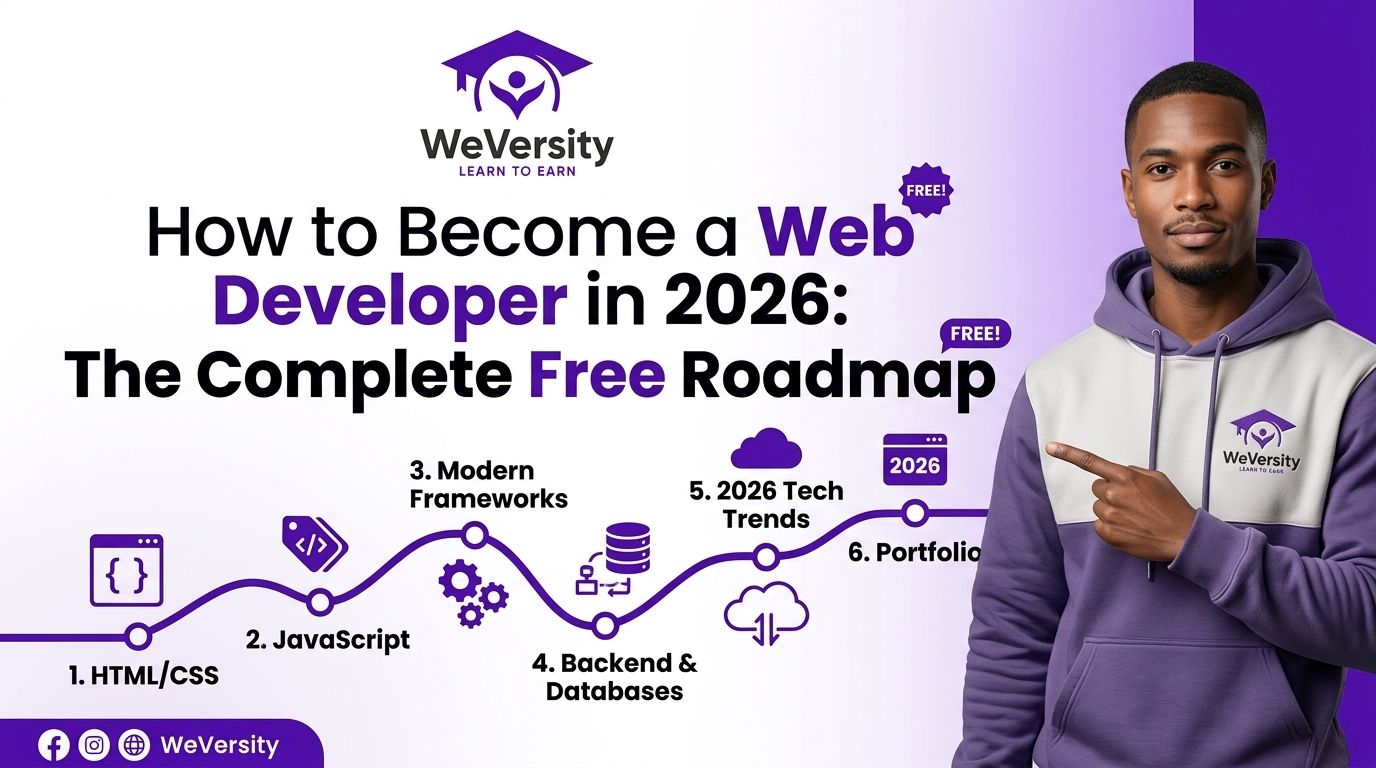
Becoming a web developer means learning to build websites and web applications using code, then proving those skills through real projects. You do not need a college degree. You need a clear order to learn things in, consistent practice, and a portfolio that shows what you can build. As a rough illustration, self-taught learners studying consistently often describe reaching a job-ready level somewhere in the nine- to fifteen-month range, while a focused bootcamp is commonly three to six months, though actual pace varies widely by person.
This web development roadmap for 2026 lays out that order step by step, with no wasted detours, so you can learn web development free and in the right sequence.
What Does a Web Developer Actually Do?
A web developer writes the code that makes websites and web applications work. That includes the layout you see on screen, the buttons that respond when clicked, and the systems behind the scenes that store data and handle logins.
The work splits into two halves:
Area
What it covers
Common languages
Frontend
Everything a visitor sees and interacts with
HTML, CSS, JavaScript
Backend
Servers, databases, and application logic
Python, PHP, Node.js, SQL
A developer who works across both is called a full-stack developer.
Do You Need a Degree to Become a Web Developer?
No single answer fits every employer. According to the U.S. Bureau of Labor Statistics, educational requirements for web development and related roles range from a high school diploma to a bachelor's degree, depending on the specific role and the employer. Many employers in this field weigh demonstrated project work alongside formal education rather than requiring a degree outright, and the field has a well-established track record of self-taught developers and bootcamp graduates moving into the role. A working portfolio is generally considered a meaningful part of a hiring decision, though how much weight it carries next to formal credentials still varies by company and role.
A degree can still help with certain employers, especially larger companies with formal hiring pipelines. But it is not the only path in, and for many learners it is not the fastest one.
Frontend, Backend, or Full Stack: Which Path Fits You?
You do not have to choose permanently on day one. Most developers start on one side and expand later. Here is a simple way to think about it:
- Choose frontend if you enjoy visual design, layout, and building things people click and see.
- Choose backend if you prefer logic, data, and how systems work behind the scenes.
- Choose full stack once you are comfortable with the basics of both, usually after your first few months of learning.
Popular frontend frameworks in 2026 include React, Next.js, and Vue.js. React has appeared among the most used frontend frameworks in past editions of Stack Overflow's annual Developer Survey, though usage rankings shift from year to year, so it is worth checking the current survey directly rather than assuming last year's standing still holds. On the backend, common choices are Node.js with Express, Python with Django, and PHP with Laravel.
The Step-by-Step Roadmap
This is the order that keeps beginners from getting stuck or wasting months on the wrong priority.
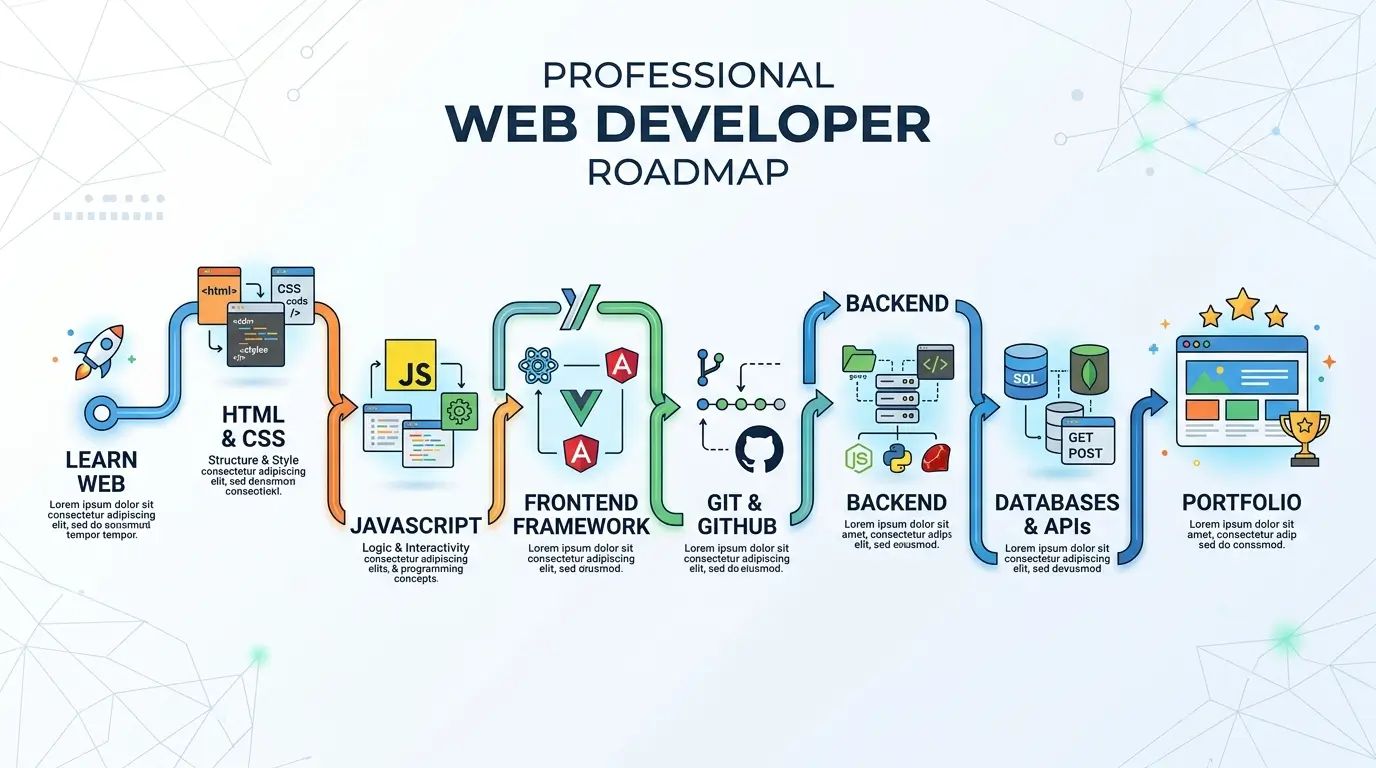
- Learn how the web works. Understand what a domain is, what a browser request does, and how a server responds. This takes a day or two, not weeks.
- Learn HTML and CSS. These build the structure and appearance of a page. WeVersity's HTML course and CSS course walk through both from scratch, with a focus on semantic HTML and responsive layout tools like Flexbox and CSS Grid.
- Learn JavaScript before touching a framework. This is the step most beginners rush, and it causes real problems later. Without solid JavaScript fundamentals, frameworks become confusing rather than helpful, and debugging turns into guesswork.
- Pick one frontend framework. React has appeared among the most used frontend frameworks in past Stack Overflow Developer Survey editions, though Vue.js is a strong, simpler alternative for beginners, and it is worth checking current survey data before settling on one.
- Learn Git and GitHub. Version control is a core skill for most professional development environments, and it is how developers collaborate on real projects. Practice basic commands like commit, push, and pull, and get comfortable with the pull request workflow.
- Choose a backend language and build with it. Node.js pairs naturally with JavaScript knowledge you already have. Python and PHP are also strong, well-documented options.
- Learn databases and APIs. Understand how an application stores and retrieves data and how different parts of a system talk to each other.
- Build a portfolio of three to five real projects. This is one of the most important steps for demonstrating job-ready ability. A working project you can explain in an interview outperforms a stack of course completion certificates.
How Long Does It Take to Become a Web Developer?
Learning path
Typical timeline
Self-taught, consistent daily practice
9 to 15 months
Structured bootcamp
3 to 6 months
Casual, inconsistent study
Highly variable, often over 2 years
These ranges reflect timelines commonly reported by coding bootcamps and career training platforms rather than a single fixed standard, since individual pace depends heavily on prior experience and hours practiced per week. The biggest factor is not talent. It is consistency. Regular practice, even in short sessions, moves learners forward faster than occasional long study bursts.
Free Ways to Learn Web Development
You do not need to pay for a bootcamp to learn web development for free and still become job ready. Free options include:
- Structured free courses that walk through HTML, CSS, JavaScript, and backend basics in order
- Live, instructor-led sessions where you can ask questions in real time
- Open-source projects on GitHub, which double as portfolio pieces and real collaboration practice
- Community forums and study groups for accountability
WeVersity's course library offers free courses in web development and programming, along with live sessions and mentorship, built specifically for learners who want a structured, guided path without the cost of a traditional bootcamp.
Common Mistakes Beginners Make
- Jumping to React before learning JavaScript well. This is the single most repeated warning from experienced developers, and it is repeated for good reason.
- Collecting courses instead of building projects. Watching tutorials feels like progress, but hiring managers look for things you built, not courses you finished.
- Skipping Git and GitHub. Waiting until "later" to learn version control makes real collaboration harder when you eventually need it.
- Trying to learn everything at once. Depth in a smaller set of tools beats shallow exposure to many.
Coding With AI Tools in 2026
AI coding assistants are now a normal part of the job, not an optional extra. Tools built into code editors can generate a working function, suggest a fix, or draft a first pass at a component in seconds. That speeds up the mechanical parts of the work, but it does not remove the need to understand what the code actually does. A developer who cannot read, test, and explain the code an AI tool produced cannot debug it when it breaks, cannot judge whether it introduces a security issue, and cannot defend a decision in a code review. Treat AI tools as a fast first draft, not a substitute for learning the fundamentals in this roadmap. The developers getting hired in 2026 are the ones who can use these tools well and still catch their mistakes.
How to Land Your First Web Developer Job
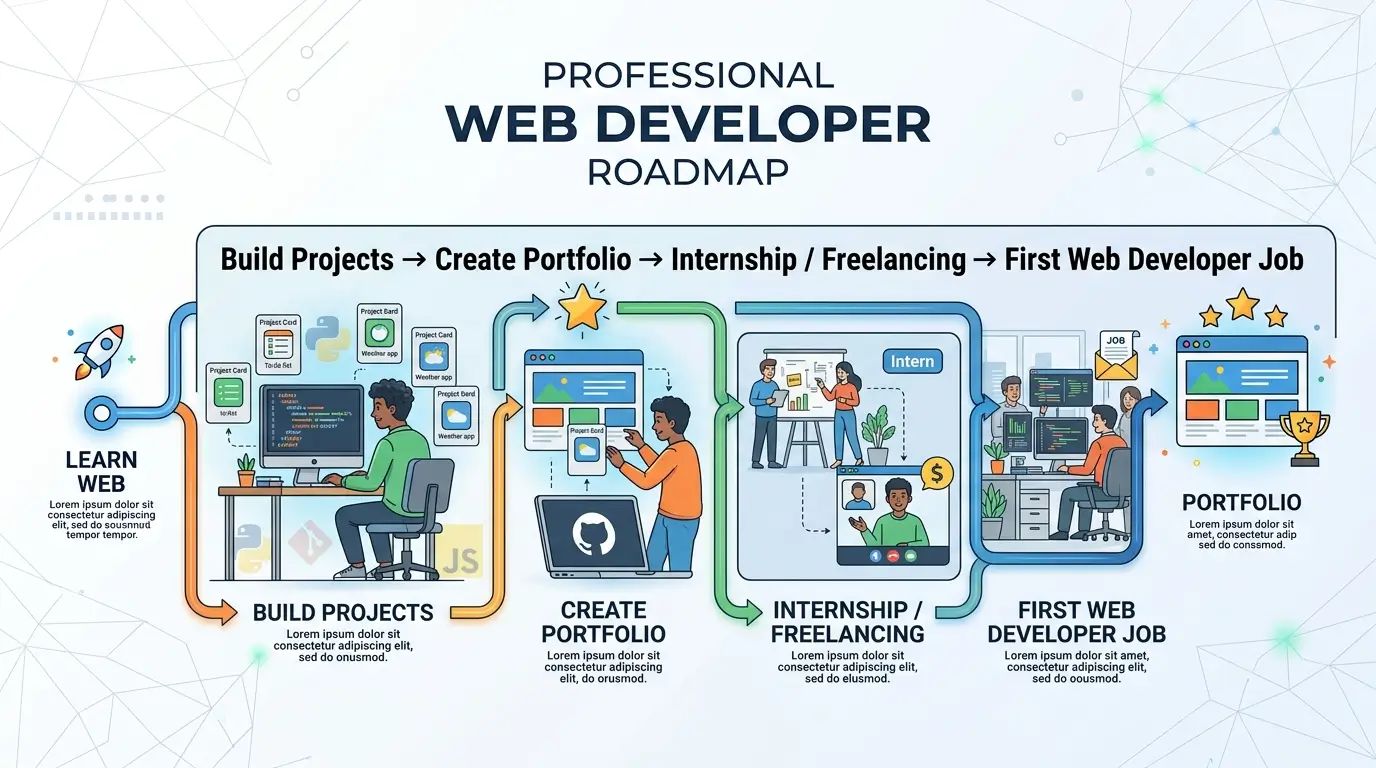
A portfolio is the strongest proof of skill a beginner can offer. Three to five complete projects, each one you can explain clearly, matter more than a long list of tutorials completed.
Other paths into a first role include:
- Internships, which give you real project experience and often lead directly to job offers. WeVersity's free virtual internship program is built for exactly this stage.
- Freelancing, which builds both a portfolio and client communication skills at the same time
- Contributing to open-source projects, which shows collaboration ability to employers reviewing your GitHub profile
On pay, the U.S. Bureau of Labor Statistics reports a median annual wage of $92,650 for web developers specifically as of May 2025, with the lowest ten percent earning under $48,100 and the highest ten percent earning over $162,290. The BLS projects the web developer role itself to grow 4 percent from 2025 to 2035, adding about 3,300 positions, faster than the 3 percent growth projected across all occupations combined. The wider category the BLS tracks, "web developers and digital designers," which folds in design-focused roles, is projected to grow 5 percent with about 13,600 openings a year, largely from workers transferring out or retiring. Location, experience, and specialization all affect where an individual salary lands within that range.
Start Learning
There is no single fastest route into web development, since pace depends on prior experience, hours practiced, and the path chosen. What consistently works is to start building rather than keep researching the perfect starting point. Pick HTML and CSS, build one small page this week, and move to the next step from there. WeVersity's free courses and live sessions follow the exact order in this roadmap, with real instructors available to help when you get stuck. For a fuller picture of how the pieces fit together, see WeVersity's guide to earning through web development.