

Yes, you can make a career change at any age. In hiring and freelancing, what you can show matters a great deal, and most people already change jobs many times in one working life. In the United States, people born between 1957 and 1964 held an average of 12.9 jobs between ages 18 and 58, according to the U.S. Bureau of Labor Statistics.
This guide is for anyone in their 20s, 30s, 40s, 50s, or beyond who wants different work. It is also for people who missed the age limits of government training programs in Pakistan. You will get a 7-step plan, a list of careers you can learn online, free training options, and a 90-day action plan.
- Is it too late? No. Age matters less than proof of skill.
- How long does it take? It depends on your weekly study time. WeVersity's programs run three months, and earning usually takes extra practice after that.
- Do you need a degree? Not for most freelance and digital work. A portfolio matters more.
- Can you learn for free? Yes. Several programs in Pakistan cost nothing, including WeVersity.
Can You Really Make a Career Change at Any Age? What the Data Shows
The data points one way: work keeps changing, so people keep changing with it. The World Economic Forum's Future of Jobs Report 2025 expects 39% of workers' current skills to change or become outdated between 2025 and 2030. It also estimates that 59 out of every 100 workers will need training by 2030.
That means learning a new skill in your 40s is no longer unusual. It is becoming normal. If you still doubt yourself, read why no one is really too old to learn.
Job changes do slow down with age. BLS data shows people in that same 1957 to 1964 group held about 5.6 jobs between ages 18 and 24, while men held only 2.1 jobs between ages 45 and 54. Fewer moves later in life is a habit, not a limit.
Career Change Myths vs. Facts
Myth
Fact
"I am too old to learn computers."
Digital skills are learned through practice, and age does not stop you from practicing.
"I will have to start from zero."
Your communication, discipline, and customer handling skills move with you.
"Clients only hire young people."
Freelance profiles are built around your portfolio, reviews, and skills, not your age.
"I need a degree first."
Most freelance platforms ask for proof of work, not a degree.
"Good training is expensive."
Several strong programs in Pakistan are free.
Career Change, Career Pivot, or Job Change: Know What You Are Planning
These terms sound similar but lead to different plans.
Term
What it means
Example
Job change
Same field, new employer
An accountant moves to a bigger firm
Career pivot
A nearby field that uses your skills
A teacher becomes a corporate trainer
Career change
A new field with new skills
A shopkeeper learns e-commerce management.
Upskilling
Improving skills for your current role
A designer learns AI image tools.
Reskilling
Learning skills for a new role
A clerk learns web development.
A pivot is usually faster because more of your experience transfers. A full change takes longer but can open bigger doors.
What Changes When You Switch Careers in Your 20s, 30s, 40s, 50s, and 60s
Every age brings a different advantage. The trick is to use it.
Age
Your biggest advantage
Your biggest challenge
Best first move
20s
Time and fewer money pressures
Little work history
Try two skills briefly, then commit to one.
30s
Real work experience
Family and rent responsibilities
Learn part-time while you keep your job.
40s
Judgment and a wide network
Fear of looking like a beginner
Pick a field close to your past work.
50s
Deep expertise and patience
Self-doubt about technology
Turn your experience into teaching, consulting, or writing.
60+
Wisdom and flexible time
Energy and health limits
Choose flexible, home-based, or project work.
How to Make a Career Change at Any Age: A 7-Step Plan
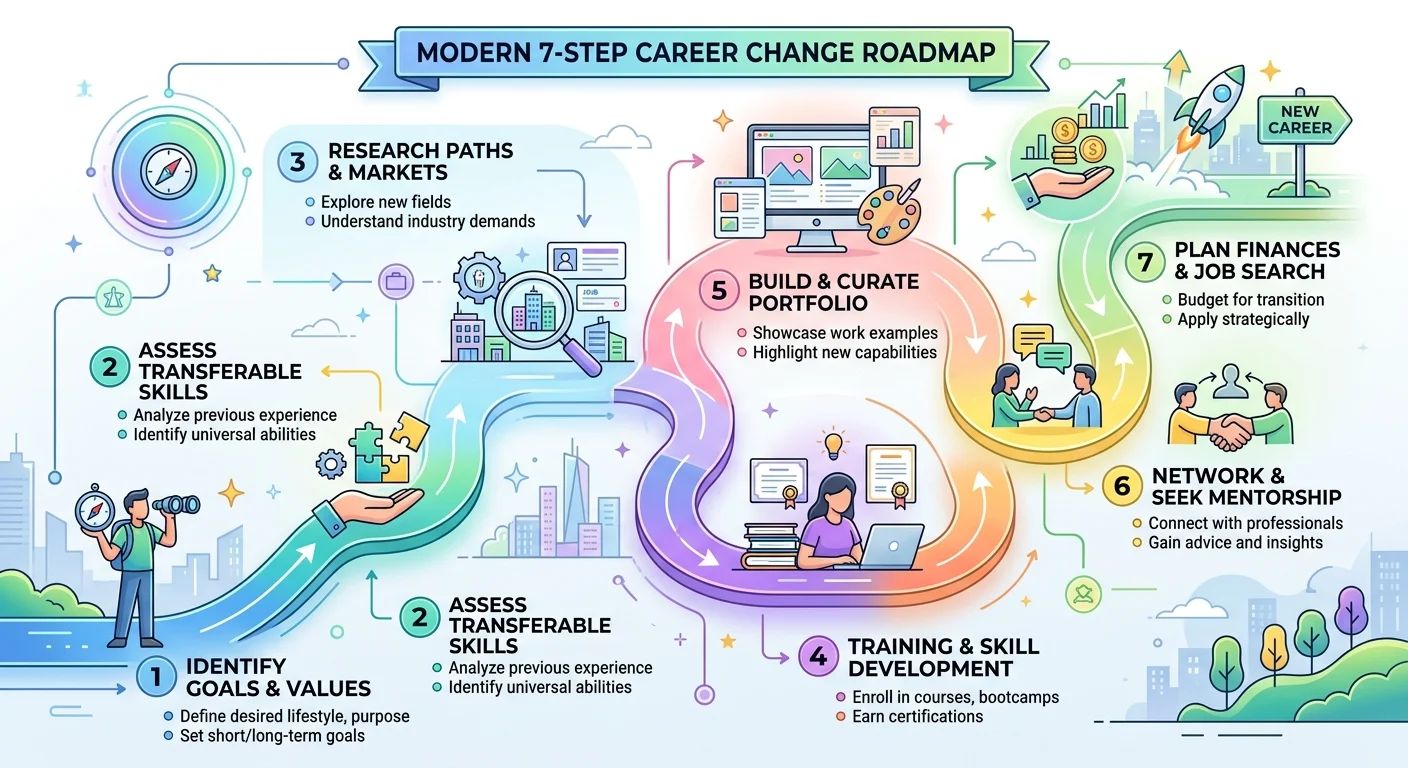
Treat your change as a project with small, testable stages. Quitting first and planning later puts your savings at risk.
Step 1: Know Your Reason and Your Limits
Write down why you want to change and what you cannot give up. Note the minimum monthly income you need, the hours you can study each week, and your family duties. A clear reason keeps you going in month two, when motivation drops.
Step 2: List Your Transferable Skills
Transferable skills are abilities that work in any field. Examples include:
- A teacher explains clearly, which suits online tutoring, training, or content writing.
- A shopkeeper understands customers and stock, which suits e-commerce management.
- An office clerk is organized and accurate, which suits virtual assistance or data work.
- A salesperson handles objections, which suits client work on Fiverr and Upwork.
Step 3: Research Careers, Not Just Job Titles
For each option, check four things: demand, time to first income, cost to learn, and whether you can do it from home. Talk to two people already doing the work before you decide.
Step 4: Test the Field Before You Quit
Take a free short course, do one small paid task, or volunteer for a local business. A small real test often teaches you more than weeks of watching videos.
Step 5: Close the Skill Gap With Focused Training
Learn one skill properly instead of five skills halfway. Choose training with practice tasks, feedback, and someone who checks your progress. Structure and regular feedback make it easier to finish.
Step 6: Build Proof of Your Skill
Clients hire proof. Build three to five portfolio samples, complete an internship, or finish one real client project. At WeVersity, every learner completes a three-month internship before receiving full certification. When your samples are ready, follow this guide to landing your first freelance clients.
Step 7: Plan Your Money and Timeline
Save enough to cover at least three months of basic expenses if possible. Keep your current income while you learn. Expect your first earnings to be small. Give yourself at least six months of steady effort before you judge the results.
How to Change Careers With No Experience or No Degree
Expect to start one level lower than your old job. This is often temporary, because good work habits can help you move up faster. Build experience without a job through:
- Personal projects, such as designing logos for imaginary brands
- Free work for a relative's shop or a local mosque committee, in return for a review
- An internship, paid or unpaid
- Small first orders on freelance platforms
Best Careers to Switch Into at Any Age in 2026
These fields can be learned online, done from home, and started without a degree.
Career
Learn online.
Work from home.
Good fit for
How AI affects it
Graphic design
Yes.
Yes.
Creative people of any age
AI speeds up drafts; taste and client care still win.
Content writing
Yes.
Yes.
Teachers, readers, people with clear Urdu or English
AI writes generic text; human experience sells.
E-commerce management
Yes.
Yes.
Shopkeepers and salespeople
AI helps listings; product and customer sense matter most.
Web development
Yes.
Yes.
Patient, logical learners
AI writes code faster; problem-solving stays human.
Online tutoring
Yes.
Yes.
Teachers and retired professionals
Low risk; personal teaching is hard to replace.
Virtual assistance
Yes.
Yes.
Organized office workers
Routine tasks shrink; coordination grows.
WeVersity teaches the first four as three-month master credential programs in Urdu and Hindi.
Career Change at Any Age in Pakistan: Free Training and Age Limits
Pakistan has good training programs, but some leave out older learners. Check eligibility before you plan around one.
Program
Cost
Age limit
Format
Coach per learner
Fee now charged, per its FAQ
Historically 35 maximum, with Punjab domicile and 16 years of education
Centers and online
No
WeVersity
Free, with scholarships
See the WeVersity student guide.
Online and onsite, Urdu and Hindi
Yes.
Details checked October 2, 2026. Program rules change often, so confirm on each official site before applying.

Freelancing as a Career Change Route
Freelancing lets you sell a skill directly to clients worldwide. Most Pakistani freelancers start on Fiverr or Upwork and receive payments through Payoneer or a bank transfer. Registering with the Pakistan Software Export Board can help with recognition and tax matters. For the full path, see our complete guide to freelancing in Pakistan.
Learning From Home as a Woman Returning to Work
Online programs let you study around family duties. Content writing, design, and virtual assistance fit flexible hours well.
How to Handle the Fears of a Late Career Change
Fear
A practical response
"What will people say?"
Share your plan only after your first small result. Results quiet critics.
"I will fail."
Test small first. A failed test costs a week, not your savings.
"I wasted years in my old field."
Those years built the skills that make you faster now.
"I feel like a fraud."
Every expert was once a beginner. Show your work, not your age.
"I cannot afford a gap."
Keep your income and learn part-time.
Real Stories of People Who Started Again Later in Life
Fashion designer Vera Wang was a figure skater before she entered the fashion industry at age 40, as reported by U.S. News.
Stories closer to home matter more. Browse WeVersity graduates to see learners who have completed the programs.
Common Career Change Mistakes to Avoid
- Quitting before testing. Keep your income until the new skill earns.
- Paying for hype. Avoid courses that promise fixed monthly earnings.
- Learning too many skills. One skill done well beats five done halfway.
- Hiding the change in interviews. Explain it with confidence and one example.
- Giving up in month two. Slow early progress is normal.
Your 90-Day Career Change Plan
Days
Focus
Actions
1 to 30
Decide
List skills, research three careers, talk to two people, and pick one.
31 to 60
Learn
Join a structured course, practice daily, finish two portfolio samples
61 to 90
Prove
Complete a real project, create a freelance profile, and send your first pitches.