


Key takeaways
- Open a separate business bank account before you accept your first payment.
- Record every transaction weekly, and pick cash or accrual accounting and stay with it.
- Profit and cash are different numbers. Check your cash flow every week.
- If you work for yourself in the United States, nobody withholds tax for you. Plan for estimated payments and self-employment tax from your first paid job.
- Borrow only after you know your numbers. SBA-backed loans come from banks and other lenders, not from the SBA directly.
Money problems in a young business often start small. A personal card pays for a business expense. A receipt goes missing. A tax bill arrives that nobody planned for. Small business finance basics are the habits that prevent these gaps by showing you what you earn, what you owe, and what you can safely spend.
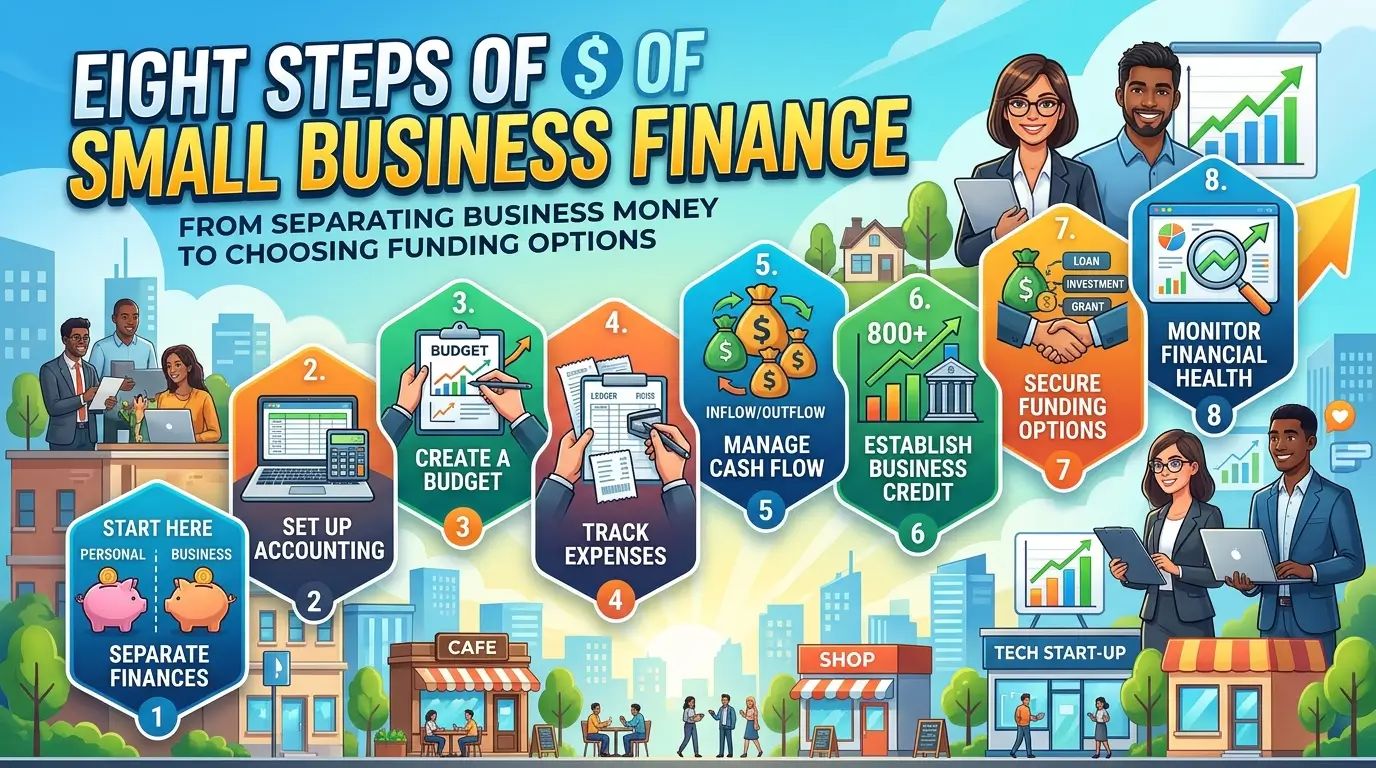
This guide covers eight steps in the order most owners need them. It includes a worked example with real arithmetic, a table of common mistakes, and a 90-day checklist. The rules and deadlines focus on the United States, and a short section near the end helps owners elsewhere.
Small Business Finance Basics: The Six Parts You Need to Know
Small business finance covers how money moves through your company: how you collect it, record it, spend it, save it, and report it to the tax authority. Six areas make up the core.
Area
The question it answers
Where to find it
Accounts
Is business money kept apart from mine?
Step 1
Structure and tax ID
How is my business set up legally and for tax?
Step 2
Bookkeeping
What came in, and what went out?
Step 3
Financial statements
Am I profitable, and what do I own and owe?
Step 4
Budget and cash flow
Can I pay my bills next month?
Steps 5 and 6
Taxes and funding
What do I owe, and how do I pay for growth?
Steps 7 and 8
Step 1: Keep Business Money Separate from Your Own
Open a business checking account and use it only for business income and expenses. A business credit card is optional, but if you get one, use it only for business purchases.
This one habit does three jobs. It gives you clean records, it makes tax preparation faster, and it supports the legal separation between you and your company if you form an LLC or corporation. Mixing personal and business money can weaken that separation.
How you pay yourself depends on your structure. Sole proprietors and most LLC owners usually move money from the business account to a personal account, often called an owner's draw. Owners of corporations are typically paid through payroll. Ask your accountant which applies to you.
What to bring to the bank:
- Government photo ID
- Your EIN, or your Social Security number if you are a sole proprietor without one
- Formation documents if you have an LLC or corporation
- Any business license your city or state requires
Step 2: Choose a Business Structure and Get an EIN
Your structure decides how your profit is taxed and how much of your own property is exposed if the business has debts. The IRS explains the main types in its business structures guide. Rules vary by state, so treat this table as a starting point.
Structure
Owner liability
How profit is taxed by default (federal)
Sole proprietorship
The owner is personally responsible for business debts.
Reported on the owner's personal return
Single-member LLC
Generally separates personal and business assets
Same as a sole proprietorship unless you elect otherwise
Partnership or multi-member LLC
Varies; general partners are personally responsible
Partnership return, with profit passed to the owners
C corporation
Separate legal entity; owners generally protected
The corporation pays its own income tax.
S corporation (a tax election)
Same legal protection as the underlying corporation or LLC
Profit passes to the owners' personal returns.
Talk with a CPA or business attorney before you choose, especially if you plan to hire people or bring in partners.

Your EIN. An Employer Identification Number is a nine-digit tax ID for your business. The IRS issues it for free through its online EIN application, and you should never pay a third party for one. You generally need an EIN if you have employees or operate as a partnership or corporation. A sole proprietor without employees can often use a Social Security number instead, but many banks ask for an EIN anyway, and having one keeps your personal number off client forms.
Step 3: Set Up Bookkeeping You Will Keep Up With
Bookkeeping is the day-to-day recording of every transaction. Accounting uses those records to produce reports and guide decisions. If the records are wrong, every report built on them is wrong too.
Pick a method: cash or accrual. The SBA's manage your finances guide gives a simple test. If you make a sale in January and the customer pays in February, the accrual method records it in January, while the cash method records it in February.
Method
When income is recorded
When expenses are recorded
Often fits
Cash
When you receive payment
When you pay the bill
Freelancers and very small businesses
Accrual
When you earn it
When you incur it
Businesses with inventory or customers who pay on credit
Some businesses must use accrual accounting under tax rules, so confirm your choice with a tax professional. Once you pick a method, apply it the same way every month.
Build a chart of accounts. This is the list of categories your transactions fall into, such as sales, software, advertising, contractor payments, and owner draws. Keep it short at first. You can split a category later, but a long list at the start leads to messy records.
Choose a tool. Cloud accounting software such as QuickBooks, Xero, or FreshBooks can pull in bank transactions automatically. A spreadsheet also works for a very small business if you update it on schedule.
Follow a weekly routine. Set aside 30 minutes at the same time each week:
- Match new bank transactions to categories.
- Save or photograph every receipt.
- Send invoices for finished work.
- Check which invoices are unpaid and follow up.
Once a month, reconcile your records to the bank statement. This means confirming that your balance matches the bank's balance and explaining any difference.
Step 4: Read the Three Financial Statements
Three reports tell you how the business is doing. Lenders, investors, and tax preparers will ask for them, so learn to read them early.
Report
What it shows
Question it answers
Profit and loss statement (income statement)
Revenue minus expenses over a period
Did I make money this month?
Balance sheet
Assets, liabilities, and owner equity on one date
What do I own and what do I owe?
Cash flow statement
Cash moving in and out, split into operating, investing, and financing
Where did my cash go?
The SBA calls the balance sheet a snapshot of your business at one point in time. Here is what its three parts mean in practice:
- Assets are things you own or are owed, such as cash, equipment, inventory, and money customers have not paid yet (accounts receivable).
- Liabilities are what you owe, such as loans, unpaid bills (accounts payable), and taxes due.
- Equity is what remains for the owner after liabilities are subtracted from assets.
Review all three reports once a month. Compare each month with the one before it, and look for expenses that grew faster than sales.
Step 5: Build Your First Budget
A budget is a plan for your money that you compare against what actually happens. Build it in this order:
- List one-time startup costs. Equipment, registration fees, a website, first inventory, and insurance deposits.
- List fixed monthly costs. Software subscriptions, insurance, loan payments, and rent.
- List variable costs. Materials, shipping, payment processing fees, and advertising. These rise and fall with sales.
- Estimate sales with caution. Use the low end of what you expect, not the best case.
- Set owner pay. Decide what you will take from the business each month, even if it is small.
- Compare and adjust monthly. Note where reality differed from the plan and change the next month's budget.
If your income changes a lot from month to month, our guide on how to build a budget when you're freelancing with irregular income shows how to plan around the lean months.
Know your break-even point. This is the sales level where you cover all costs and make no profit and no loss. The formula is:
Break-even units = Fixed costs ÷ (Selling price − Variable cost per unit)
Example: your fixed costs are $1,200 a month. You sell a product for $40, and each one costs $15 to make and ship. That leaves $25 from every sale to cover your fixed costs. Divide $1,200 by $25 and you get 48, so you need 48 sales a month to break even.
Your price must cover costs, taxes, and your own pay. If it covers only the first, you have a hobby, not a business.
Step 6: Manage Cash Flow Every Week
Cash flow is the timing of money moving in and out of your bank account. The U.S. Chamber of Commerce guide to small business accounting ties it to liquidity, meaning how much cash you can reach right away. A business can show a profit on paper and still miss payroll if customers pay late.
Ways to protect your cash:
- Invoice the day work is finished, not at the end of the month.
- Shorten payment terms, for example, due in 14 days instead of 30.
- Ask for a deposit on large projects.
- Follow up the day after an invoice becomes overdue.
- Offer easy payment methods such as bank transfer or card.
- Review upcoming bills every week so none surprises you.
Build a cash reserve. A practical first goal is enough to cover one to three months of fixed costs. Aim higher if your income swings a lot.
Build a 13-week forecast. Use a simple table and update it weekly:
Week
Starting cash
Expected cash in
Expected cash out
Ending cash
1
Today's bank balance
Invoices you expect to be paid
Bills, payroll, and taxes due
Starting cash + cash in − cash out
2
Last week's ending cash
Repeat the process
Repeat the process
Repeat the process
If any ending balance drops near zero, you have time to chase invoices, delay a purchase, or arrange a credit line before it becomes an emergency.
Step 7: Plan for Taxes Before the Bill Arrives
This section covers United States federal rules for the 2026 tax year. Your state may add its own income tax, sales tax, or other filings.
When you work for an employer, tax comes out of each paycheck. When you work for yourself, nobody does that, so you pay as you earn. You owe two main federal taxes on your profit:
- Income tax, based on your taxable income.
- Self-employment tax (SE tax), which covers Social Security and Medicare. The rate is 15.3 percent: 12.4 percent for Social Security and 2.9 percent for Medicare. You figure it on Schedule SE. The Social Security part stops at an annual earnings cap that the government adjusts each year, and very high earners pay an extra 0.9 percent Medicare tax.
Estimated tax payments. You generally pay these four times a year using Form 1040-ES if you expect to owe $1,000 or more for the year after credits and withholding, according to the IRS estimated taxes guide. The four periods are uneven. For the 2026 tax year, the schedule is:
Income earned in 2026
Payment due
January 1 to March 31
April 15, 2026
April 1 to May 31
June 15, 2026
June 1 to August 31
September 15, 2026
September 1 to December 31
January 15, 2027
You can skip the January 15, 2027 payment if you file your full 2026 return by February 1, 2027 and pay the whole balance with it. When a due date falls on a weekend or holiday, it moves to the next business day.
Avoiding penalties. IRS Publication 505 explains a safe harbor. You can avoid an underpayment penalty by paying at least 90 percent of your current-year tax or 100 percent of your prior-year tax, whichever is smaller. If your prior-year adjusted gross income was more than 150,000(75,000 (if married filing separately), the prior-year figure rises to 110 percent.
How to pay. IRS Direct Pay lets you pay from a bank account for free. You can also pay through your IRS Online Account.
Build a tax set-aside habit.
- Open a separate savings account for taxes.
- Each time a client pays you, move a fixed percentage into that account the same day.
- Choose the percentage with a tax professional, because it depends on your profit, your state, and your deductions.
- After your first quarter, compare what you saved to what you owed, and adjust.
Other obligations to ask about: state income tax, sales tax if you sell taxable goods or services, payroll taxes once you hire, and information forms for contractors you pay.
Step 8: Know Your Funding Options Before You Need Money
Looking for money in a hurry leads to costly choices. Learn the options while your finances are calm.
Option
How it works
What to watch
Personal savings
You put your own money in
Record it as an owner contribution so it stays separate.
Business credit card
Revolving credit for business purchases
Interest grows fast if you carry a balance
Business line of credit
You borrow as needed up to a limit.
Terms and rates set by the lender
SBA-backed 7(a) loan
A private lender makes the loan, and the SBA guarantees part of it
Lenders decide approval, and paperwork can be heavy.
Grants
Money you do not repay
Competitive, with narrow eligibility rules
Investors
Cash in exchange for part ownership
You give up equity and some control.
Invoice financing
An advance against unpaid invoices
Fees can be high.
The SBA states that most 7(a) loans have a maximum amount of $5 million, and lenders pay a guaranty fee that they may pass on to the borrower. The SBA does not make these loans itself. To find lenders, use its free Lender Match tool.
Before you borrow, calculate the monthly payment and check it against your cash flow forecast. If the payment would leave your forecast near zero, wait or borrow less.
Money Mistakes New Owners Make and How to Fix Them
Mistake
What happens
Fix
Mixing personal and business money
Messy records and slow tax preparation
Use a separate account (Step 1)
No tax set aside
A large bill and possible penalties
Move a percentage of every payment and pay quarterly (Step 7)
Recording transactions late
Lost receipts and missed deductions
Hold a 30-minute weekly session (Step 3)
Confusing revenue with profit
Overspending money you have not earned
Read the profit and loss statement monthly (Step 4)
Ignoring unpaid invoices
A cash gap despite strong sales
Invoice fast and follow up (Step 6)
Underpricing
Sales that do not cover costs or taxes
Price using your break-even point (Step 5)
Never asking for professional help
Expensive errors in structure or tax
Hire a CPA for setup and an annual review.
A Worked Example: One Freelancer's First Month
The numbers below are an illustration, not a real client. They show how the steps work together. Imagine a freelance web designer in the United States who uses the cash method.
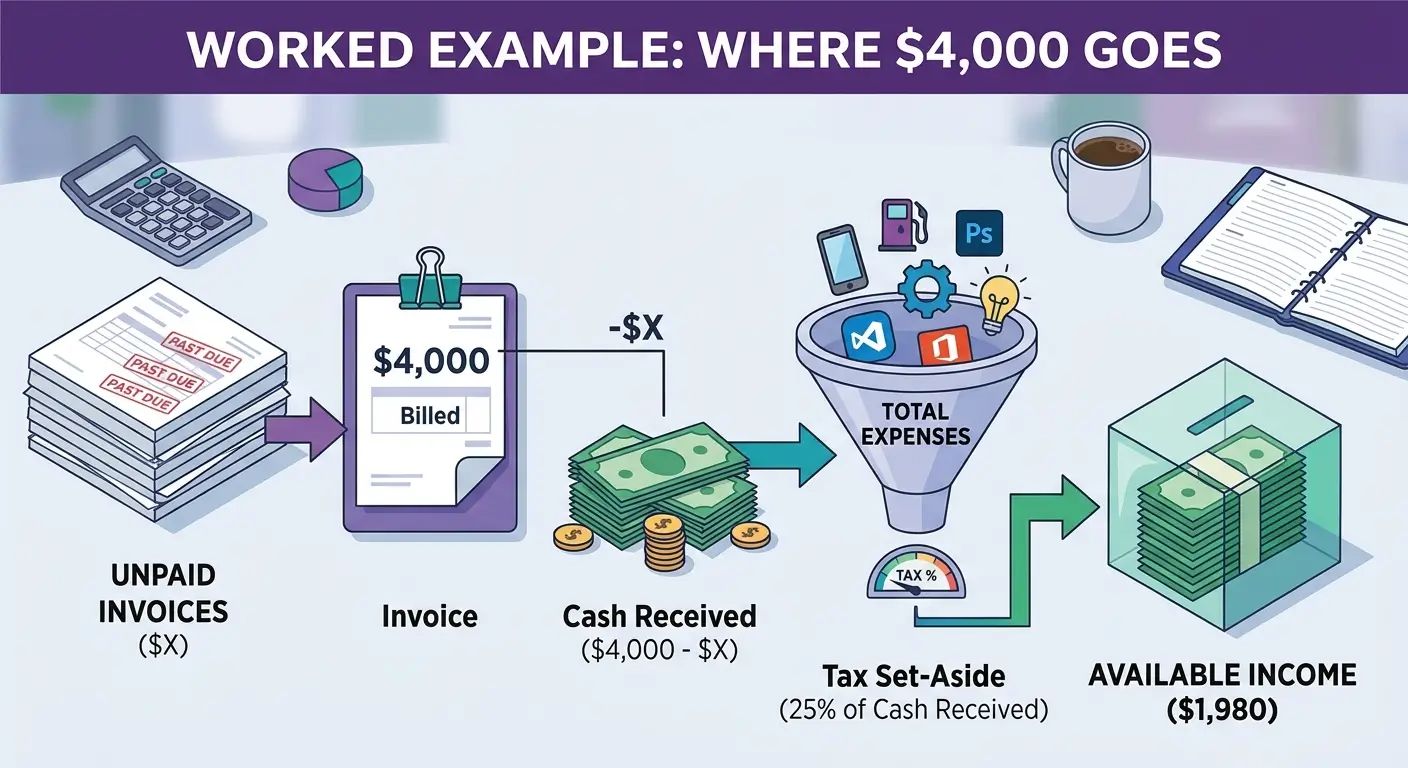
In month one, she bills clients $4,000. Clients pay $3,000 by the end of the month, and one client still owes $1,000. She pays $360 in business costs: $150 for software, $40 for website hosting, $60 for her business share of internet and phone, $100 for advertising, and $10 in bank fees.
Line
Amount
Billed to clients
$4,000
Collected in cash
$3,000
Still owed by one client
$1,000
Business expenses paid
$360
Net profit on a cash basis
$2,640
Set aside for taxes at 25 percent (a placeholder rate)
$660
Left for owner pay and savings
$1,980
Here is the tax check. The IRS applies the SE tax rate to 92.35 percent of net earnings, not the full amount
Calculation
Result
Taxable SE earnings: $2,640 × 92.35%
about $2,438
SE tax: $2,438 × 15.3%
about $373
Left for income tax: $660 − $373
about $287
Income tax comes on top of SE tax and depends on her total income, deductions, and state. The 25 percent rate is only a starting guess she would test with an accountant.
What the example shows:
- She billed $4,000 but can freely use only $1,980 of it this month.
- The unpaid $1,000 does not count as cash income under her method until it arrives, yet it affects her planning.
- She moved the tax money into a separate account the day payments arrived, so the bill will not surprise her.
- Real quarterly calculations use year-to-date income and the worksheet in Form 1040-ES, so a single month is only a rough guide.
Your First 90 Days: A Finance Setup Checklist
Timeframe
Tasks
Week 1
Pick your structure after talking with a CPA or attorney. Get an EIN if you need one. Open a business bank account.
Weeks 2 and 3
Choose accounting software or a spreadsheet. Set up your chart of accounts. Connect your bank feed. Open a separate tax savings account.
Month 1
Write your first budget. Create an invoice template with clear payment terms. Start your weekly 30-minute routine.
Month 2
Reconcile your first full month to the bank statement. Read all three financial statements. Note your first estimated tax due date.
Month 3
Build your 13-week cash forecast. Check your pricing against your break-even point. Meet with a CPA to review your setup.
If You Run a Business Outside the United States
The core habits stay the same wherever you live: separate accounts, steady bookkeeping, a budget, and a cash forecast. Managing money as a new entrepreneur outside the United States mainly changes the tax and registration details, so the IRS rules in this guide will not apply.
What to check locally:
- Your national tax authority. Find its website and learn how business income is taxed and how often you must file or pay.
- Business registration and tax ID. Many countries require a registered business before you can open a business account.
- Sales tax or value-added tax. Some countries require you to charge and report it once you pass a certain sales level.
- Foreign payments. If clients pay you in another currency, record the amount in your local currency using the exchange rate on the day you are paid. Record platform and transfer fees as a separate expense so your income figure stays accurate.
A local accountant can confirm each of these in one or two meetings and is worth the cost early on. If you are building a freelance business in Pakistan, our complete guide to freelancing in Pakistan covers how to start, find clients, and grow.
Your Next Steps
Pick three actions for this week. Open a business bank account if you have not. Block 30 minutes on your calendar for bookkeeping. Open a savings account and name it for taxes. These small habits make every other step in this guide easier to follow.
Want to go deeper with lessons and practice? Join WeVersity's free Small Business Finance Fundamentals course and build these habits step by step.