
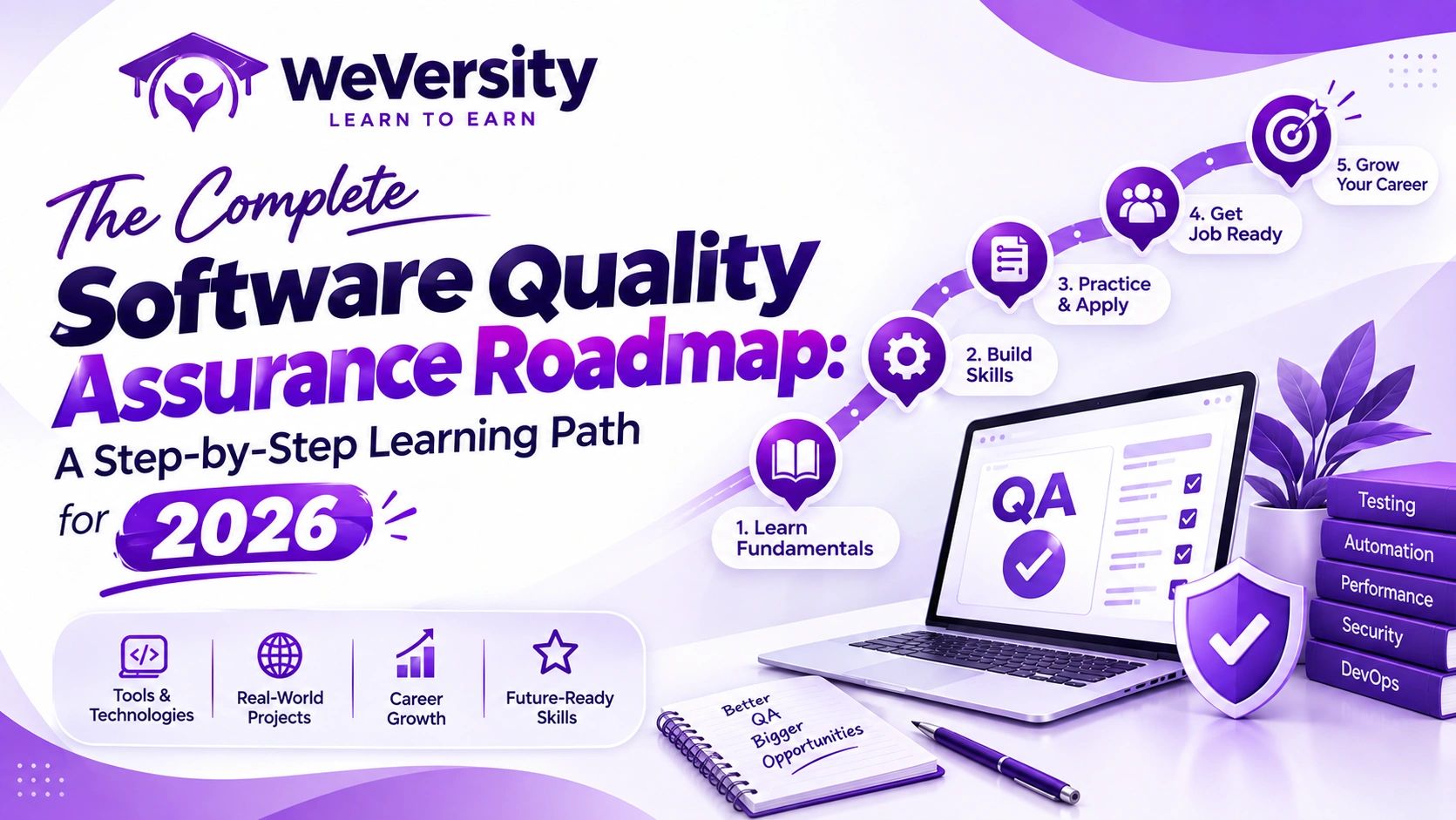

Software Quality Assurance (SQA) bridges the gap between software development and real-world reliability. Software quality assurance remains an important part of developing and maintaining reliable software systems as web applications, backend services, and enterprise platforms grow increasingly complex.
This guide provides a structured, step-by-step learning roadmap for mastering software quality assurance from absolute zero to career-ready competency.
What Has Changed for Tech Learners in 2026
The integration of artificial intelligence into development workflows has shifted how foundational technical skills are acquired, applied, and evaluated. Writing basic test scripts or syntax is no longer a sufficient differentiator in modern software engineering environments.
Key shifts impacting modern tech learners include:
- AI-Assisted Scripting and Productivity: Generative AI tools assist in automating repetitive boilerplate code, generating initial test scenarios, and streamlining documentation. Learners focus heavily on system architecture, edge-case analysis, and integration verification.
- Code Audit and Test Artifact Verification: Because AI models can produce plausible yet logically flawed code, QA engineers need strong analytical skills to audit, debug, test, and refactor AI-generated test scripts and automation suites.
- API-Centric Architectures: Modern applications rely heavily on connected services and external APIs. Understanding data routing, endpoint security, payload validation, and contract testing is increasingly relevant in QA roles involving API-driven and distributed applications.
- Automation-First Pipelines: Routine tasks across execution, reporting, and deployment are automated. Many modern technical workflows increasingly involve designing, maintaining, and monitoring continuous testing pipelines rather than relying exclusively on manual execution.
Traditional Approach ➔ Focus on Syntax, Manual Execution & Isolated Test Cases
Modern Skill Model ➔ Focus on Architecture, API Verification, AI Auditing & Automated Pipelines

Phase 1: Core SQA Principles and Testing Foundations
A solid understanding of theoretical concepts is essential before executing manual test suites or configuring automated pipelines.
Key Lifecycle Frameworks
Software testing operates within structural lifecycles that govern how applications are planned, built, and evaluated.
- Software Development Life Cycle (SDLC): The overarching framework (such as Agile Scrum, Kanban, or DevOps) detailing how software is planned, written, and deployed.
- Software Testing Life Cycle (STLC): The specific QA lifecycle covering Requirements Analysis, Test Planning, Test Case Development, Test Environment Setup, Test Execution, and Test Cycle Closure.
Requirements Analysis ➔ Test Planning ➔ Test Case Writing ➔ Test Execution ➔ Defect Reporting ➔ Closure
Essential Quality Assurance Concepts
Structured metrics and design techniques help teams measure progress and prevent redundant testing effort:
- Equivalence Partitioning & Boundary Value Analysis (BVA): Core test design techniques used to identify input boundaries and systematically select test data sets.
- Defect Severity vs. Priority: Severity measures a defect's technical impact on system functionality; priority dictates business urgency for remediation.
- Defect Cost Curve: Identifying a requirement defect during initial design phases costs substantially less than fixing a production-level flaw post-deployment.
Phase 2: Manual Testing Execution and Project Management
Before transitioning to automated frameworks, QA engineers establish strong competencies in manual execution and defect tracking.
Key Deliverables in Manual QA
QA Artifact
Description
Primary Goal
Test Plan
Strategy document outlining testing scope, target environments, schedule, and resource allocation.
Defines operational boundaries and overall test strategy.
Test Scenario
High-level grouping of functional behavior to be evaluated.
High-level grouping of functional behavior to be evaluated.
Test Case
Detailed execution steps, including preconditions, inputs, and expected outcomes.
Validates application behaviors against defined specifications.
Bug/Defect Report
Comprehensive issue record including reproduction steps, severity, environmental logs, and visual evidence.
Provides developers with actionable data to reproduce and resolve defects.
Management and Tracking Applications
Industry tools structure manual workflows and sprint tracking:
- Jira / Trello: Issue-tracking applications used for sprint planning, user story validation, and bug management. Learners can check specialized resources like the Trello Mastery Course to master project tracking workflows.
- TestRail / Zephyr: Dedicated test management environments designed for organizing test suites and logging execution runs.
Phase 3: API Testing and Database Validation
Modern application architectures rely heavily on backend APIs and relational databases. Web interface testing alone cannot verify end-to-end data integrity.

API Testing Foundations
APIs handle backend data communication between application user interfaces and server infrastructure.
- HTTP Request Methods: Working with GET, POST, PUT, PATCH, and DELETE requests.
- Status Code Verification: Validating 2xx (Success), 4xx (Client Error), and 5xx (Server Error) response codes.
- Payload Verification: Checking JSON and XML payloads against API documentation and schema specifications.
- Testing Applications: Utilizing tools like Postman or Insomnia for manual API requests, parameterization, and automated collection runs.
Database Querying for QA Engineers
QA professionals verify that application operations persist accurately to backend storage layers.
- SQL Queries: Writing SELECT, INSERT, UPDATE, and DELETE queries to verify database states.
- Data Integrity Verification: Executing multi-table JOIN operations to audit transactional relational database tables.
Phase 4: Test Automation, AI & CI/CD Integration
Automated execution accelerates regression loops and scales testing coverage across software releases.
Write Automation Scripts ➔ Commit Code to Git ➔ Trigger CI/CD Pipeline ➔ Run Automated Suites ➔ Publish Test Results
Automation Frameworks and Languages
Programming Foundations: Building proficiency in mainstream languages such as JavaScript/TypeScript or Python. Learners can review fundamental web structure through the HTML Step-by-Step Guide and the CSS Complete Course.
Modern Web Automation Frameworks:
- Playwright: Fast, cross-browser test automation engine designed for modern web applications.
- Cypress: Developer-friendly frontend test runner tailored for end-to-end testing.
- Selenium WebDriver: Established a cross-platform automation standard widely deployed across legacy enterprise systems.
Dedicated AI Automation Track
Focuses on combining testing scripts with AI tools, automating workflow pipelines, and auditing generated artifacts:
- Core Skills: Webhook triggers, automated API collection runs, AI-assisted test case generation, prompt auditing for edge cases, and workflow integration (using tools like Jenkins, GitHub Actions, or workflow automation platforms).
- Target Role Paths: AI-Assisted QA Automation Specialist, Integration Test Engineer, Workflow Automation Associate.
- Sample Portfolio Project: Build an automated test pipeline that receives API payload triggers, uses AI prompts to generate edge-case validation scenarios, audits the output, runs an automated Playwright smoke test suite in GitHub Actions, and posts execution logs to a defect tracker via webhooks.
Version Control and Continuous Integration Pipelines
Automation repositories require structured versioning and automated pipeline triggers.
- Git & GitHub: Managing code versioning, branch management, and code review pull requests.
- CI/CD Integration (Jenkins / GitHub Actions): Configuring automated test runs to execute automatically when developers merge code updates.
Focus Platform: WeVersity.org Overview
WeVersity.org is an open-access educational platform providing structured, skill-based courses in software quality assurance, web management, digital marketing, and foundational digital tools.
On WeVersity.org, learners access video modules, practical coursework, instructor-led live sessions, and self-paced quizzes. Learners can complete courses and, where offered, earn certificates of completion backed by online credential verification tools. The platform also offers student internship opportunities designed to provide practical, hands-on learning experiences.
Illustrative Cost Range for Online Skill Programs
While various open-access platforms offer accessible learning options, training costs across the broader technical education market vary based on provider structure and delivery format:
Education Format
Illustrative Cost Range
Typical Duration
Certificate Status
Open-Access Platforms
$0 for free-access learning options
Self-Paced (10–300 Hours)
Certificate availability varies
Freemium Audit Platforms
$0 Audit / $39–$79/mo for Certificate
1 to 4 Months
Paid Credential Layer
Commercial Bootcamp Programs
Illustrative range: $3,000 – $15,000+
12 to 24 Weeks
Institutional Certificate
Note: Educational program costs vary by country, provider, program length, delivery format, and course scope. The figures above are illustrative ranges rather than fixed prices.
Essential Content Gaps: Building a Job-Ready Portfolio
Demonstrating practical project outputs through a publicly accessible technical portfolio is a valuable step when applying for SQA roles:
Documenting Real-World Test Suites
Host functional testing artifacts in public repositories or technical documentation spaces:
- Publish comprehensive Markdown test plans for open-source applications.
- Upload documented manual defect reports featuring exact reproduction steps, environment details, and clear screenshots or logs.
Building an Automated Test Portfolio
Organize test automation repositories using established design patterns rather than basic recorded actions:
- Implement the Page Object Model (POM) architecture to decouple UI locators from test logic.
- Include explicit assertions for API response payloads and frontend user interface states.
- Configure continuous integration workflow files (such as GitHub Actions workflow YAML files) to showcase hands-on pipeline experience.
Selecting an Initial Skill Path
To establish a structured learning flow, follow this sequence:
1. Master Manual Fundamentals:
Study the Software Development Life Cycle (SDLC) and Software Testing Life Cycle (STLC), practice writing structured test cases, and log defect reports using Jira.
2. Learn API Testing and SQL Verification:
Practice sending HTTP requests in Postman, validating JSON payload schemas, and running SQL queries to confirm database updates.
3. Build Automation & AI Integration Skills:
Select a core programming language (such as JavaScript/TypeScript or Python), learn a modern web automation framework like Playwright or Cypress using the Page Object Model, and incorporate AI workflow automation tools.
4. Integrate and Publish Portfolio Work:
Commit your test automation projects to GitHub, configure automated pipeline runs using GitHub Actions, and link your public repositories in your resume or professional profile.