

You launched a website, waited a few weeks, and Google still sends almost nobody. In most cases the reason is simple: a search engine could not find your pages, could not understand them, or found a better answer somewhere else.
This guide to SEO for beginners walks through each of those steps in plain English. Every factual claim links to Google's own documentation or a published study, listed at the end.
Key takeaways
- SEO (search engine optimization) means helping search engines find, understand, and trust your pages so they show them in free results.
- Google works in three stages: crawling, indexing, and serving results. A page that fails an early stage never gets ranked.
- AI Overviews and AI Mode draw from the same Google index, then pick sources by running extra related searches.
- In October 2026, Google spelled out what raters look for in content: effort, originality, skill, and accuracy.
What Is SEO? A Plain English Definition
SEO, short for search engine optimization, is the work of helping search engines understand your pages and helping people decide to click your result. That is how Google's own SEO Starter Guide defines it, and the same guide admits there is no secret trick that automatically puts a site first.
SEO vs Paid Ads: What Is the Difference?
SEO (organic results)
Paid search ads
Cost per click
Free
You pay for every click.
Speed
Weeks to months
Visible the same day
When you stop
Rankings usually stay for a while.
Traffic stops at once.
Label in results.
No label
Marked "Sponsored"
Why SEO Still Matters as AI Search Grows
Google reported that AI Overviews reach more than 2.5 billion monthly users and AI Mode more than 1 billion. A page must be indexed and eligible to show a snippet before AI can use it. Basic SEO is your entry ticket to AI answers.
How Do Search Engines Work? The 3 Stages Explained
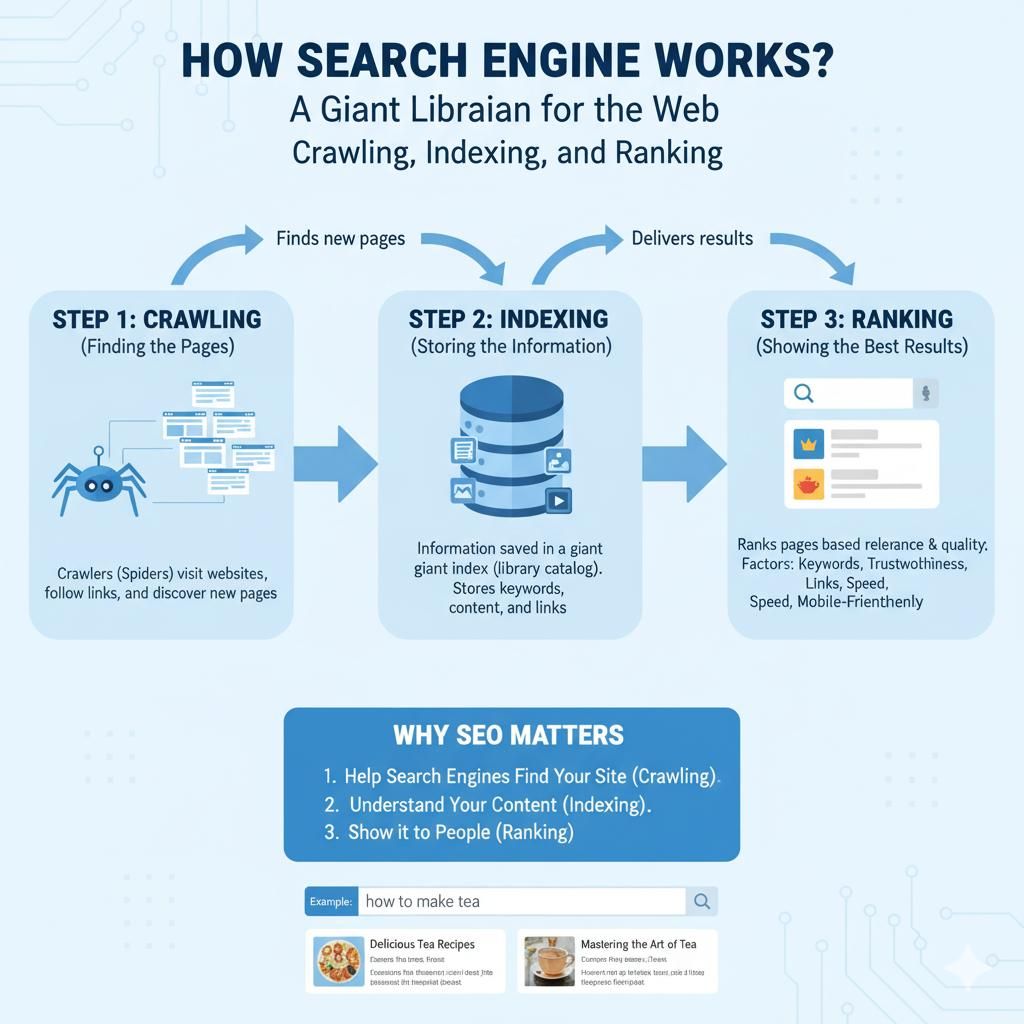
Google finds, stores, and then chooses pages in three stages, and not every page makes it through all three:
- Crawling: a program called Googlebot downloads the text, images, and videos on pages it discovers.
- Indexing: Google analyzes that content and stores it in the Google index, a very large database.
- Serving results: when someone searches, Google picks the most relevant, highest quality pages from the index.
One fact surprises most beginners: Google does not accept payment to crawl a site more often or to rank it higher.
Crawling: How Googlebot Discovers Your Pages
Crawling is the discovery step. Googlebot, Google's crawler, finds new URLs mainly through links from pages it already knows and through sitemaps. It renders pages in a recent version of Chrome, so content loaded by JavaScript can usually be seen.
How to Help Google Find New Pages
- Link every new page from at least one existing page. Google says most new pages it finds arrive through links.
- Submit an XML sitemap, a file listing your important URLs, in Search Console. WordPress creates one automatically.
What Blocks Crawling
Server errors, pages behind a login, and robots.txt rules can all stop Googlebot. To check a page, paste its address into the URL Inspection tool in Search Console and see it the way Google does.
Indexing: How Google Stores and Understands Content
Indexing is when Google reads a crawled page, works out its topic, and decides whether to store it. Indexing is never guaranteed. Google lists three common reasons a page is left out: low-quality content, a noindex rule, and site designs that hide text behind complex scripts.
Canonical Tags and Duplicate Content
When several URLs show the same content, Google picks one, the canonical URL, to show in results. Duplicates on your own site are not penalized, but they waste crawling, so redirect extra versions or add a rel="canonical" link. Copying content from other sites is different: it breaks Google's spam policies.
robots.txt vs. noindex
robots.txt
noindex tag
Controls
Crawling
Indexing
Lives in
One file at yoursite.com/robots.txt
The page's HTML or HTTP header
Best use
Keeping crawlers out of low value areas
Keeping a page out of search results
Common mistake
Using it to hide a page. A blocked URL can still appear in results if other sites link to it
Also blocking the page in robots.txt, so Google never sees the tag
Google Ranking Factors in 2026: What Decides the Top Spot
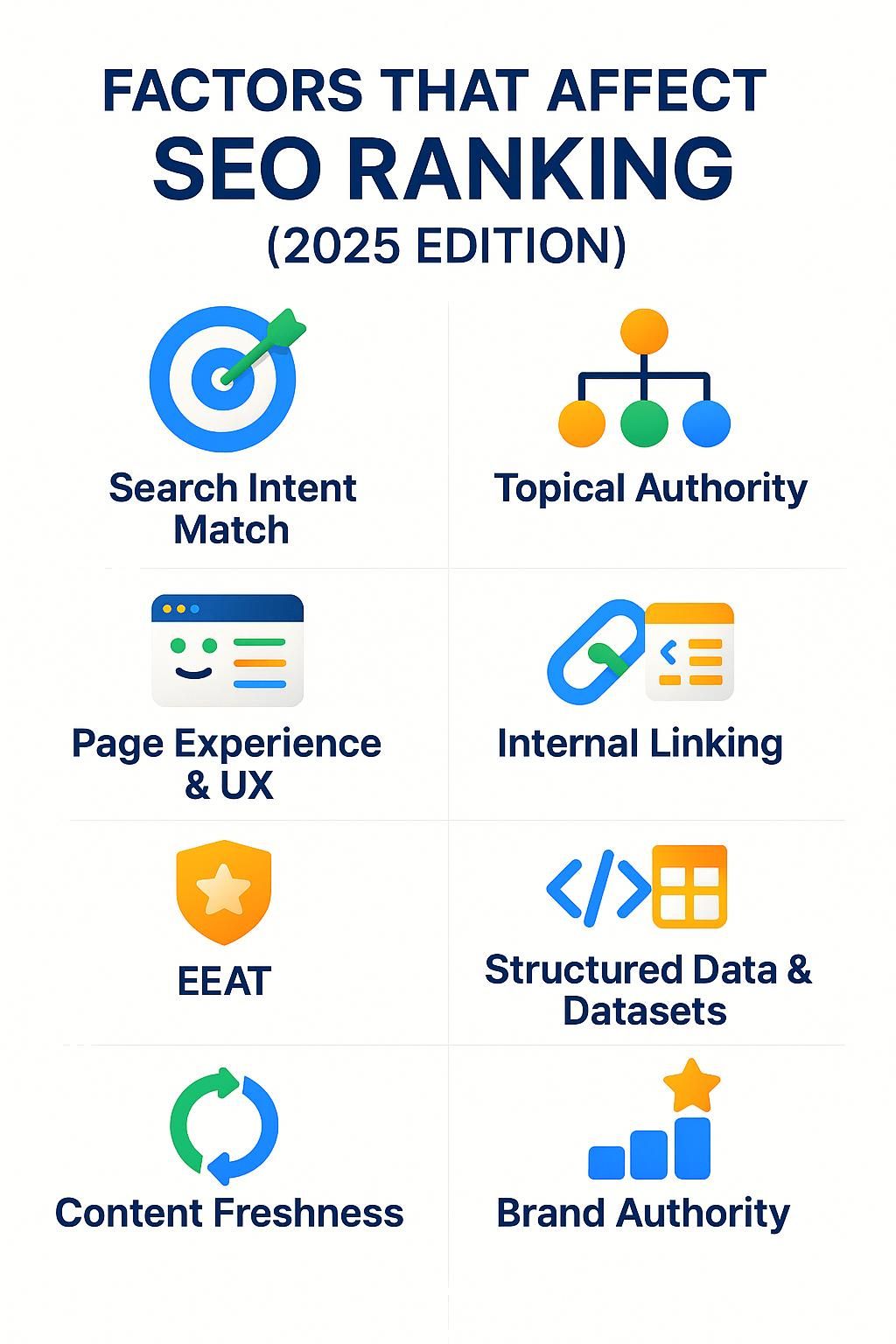
Google weighs hundreds of signals and does not publish a full list. For a new website, focus on these five areas:
Factor
What it means
What to do
Search intent
Your page type matches what searchers want: a guide, a product, a local business
Study the current top 10 results and match their format.
Helpful content
Original, accurate content written for people
Add your own experience, data, and screenshots.
Links
Other sites pointing to your pages, measured partly by PageRank
Publish resources worth citing and link your own pages together.
Page experience
Google recommends good Core Web Vitals: LCP within 2.5 seconds, INP under 200 milliseconds, and CLS under 0.1. These are performance targets that align with what Google's ranking systems reward, not a guaranteed ranking boost.
Test pages in PageSpeed Insights
Freshness
Recent information wins for time-sensitive searches
Update key pages and show the date.
Where E-E-A-T Fits
E-E-A-T stands for Experience, Expertise, Authoritativeness, and Trustworthiness. Google says it is not a ranking factor by itself; it describes the qualities its systems try to reward. You show it with a named author, real credentials, and accurate sources.
What Does Not Affect Your Rankings
Google's SEO Starter Guide lists several myths:
- The meta keywords tag. Google Search does not use it.
- Word count. There is no minimum or maximum length.
- Keywords in your domain name. They have hardly any effect.
- Paying Google. Ranking is done by programs, not payments.
AI Overviews, AI Mode, and Query Fan Out: How AI Search Picks Sources
Google's AI features first retrieve pages from the normal search index, then write an answer with links to the pages that support it. To gather more material, the model also runs several related searches at the same time, a process Google calls "query fan out" (Google).
What Query Fan Out Looks Like
Google's own example: a search for "how to fix a lawn that's full of weeds" may trigger extra searches such as "best herbicides for lawns" and "how to prevent weeds in lawns." The AI then cites whichever pages answer those smaller questions best.
That is why ranking first no longer guarantees a citation. In a March 2026 Ahrefs study of 863,000 keywords and about 4 million AI Overview URLs, 37.9% of cited pages also appeared in the top 10 results for the same query. Ahrefs' July 2025 study put that share at 76%, but Ahrefs says it has since improved how it detects citations, so the two numbers are not directly comparable. Read the drop as a direction, not an exact measurement. A page that fully covers the follow-up questions on a topic can win citations it never targeted.
How Other AI Assistants Choose Sources
Platform
Where answers come from
What to check
Google AI Overviews and AI Mode
Google's index plus fan-out searches
The Search generative AI setting in Search Console is on.
ChatGPT search
OpenAI's search crawler, OAI-SearchBot
robots.txt allows OAI-SearchBot.
Microsoft Copilot
The Bing index
Site verified in Bing Webmaster Tools
Perplexity
Its own crawler, PerplexityBot
robots.txt allows PerplexityBot
SEO vs AEO vs GEO: Do You Need Different Tactics?
AEO (answer engine optimization) and GEO (generative engine optimization) are newer names for chasing AI visibility. Google's position is clear: for its search, this is still SEO. Google says you can skip splitting content into tiny chunks, rewriting pages just for AI, and buying fake mentions.
Google's October 2026 Content Rules: Effort, Originality, and Accuracy
On October 1, 2026, Google updated two Search Central pages. Its guidance on using generative AI content added the fact-checking rule below. Its people-first helpful content page, dated the same day, now defines main content as any part of a page that directly helps it achieve its purpose. It also lists four attributes quality raters assess: effort, originality, talent or skill, and accuracy. Rater scores do not directly change rankings; Google uses them to evaluate its ranking systems.
Does Content Made With AI Rank on Google?
It can, if a human checks it. Google's generative AI guidance says AI tools predict likely words rather than look up facts, so they can make mistakes. Google calls a manual fact check critical before publishing, and that review covers titles, meta descriptions, structured data, and image alt text too. Mass-producing pages that add no value breaks Google's scaled content abuse policy.
Why Real Authors Matter More Than Ever
The helpful content page now says that fabricating creator profiles, such as AI-generated headshots, made-up names, or false credentials, is "a form of deception."
Your First Week SEO Checklist: 7 Steps
- Verify your site in Google Search Console and submit your XML sitemap.
- Add the site to Bing Webmaster Tools and turn on IndexNow, so Bing and Copilot learn about changes quickly.
- Check that robots.txt allows Googlebot, Bingbot, OAI-SearchBot, and PerplexityBot.
- Give each page one main topic that matches what the current top results offer.
- Write a unique title tag and meta description for every important page.
- Start each section with a direct two-sentence answer, then explain.
- Open the generative AI performance report in Search Console to see which pages appear in AI features.
A Worked Example: SEO for a Local Bakery
An illustrative example, not a real client. Imagine a small bakery in Faisalabad that sells custom cakes.
- Keyword research. Type "custom cake Faisalabad" into Google and note the autocomplete suggestions and People Also Ask questions. Check rough monthly volume in Google Keyword Planner. A sensible shortlist: "birthday cake Faisalabad," "custom cake delivery Faisalabad" and "eggless cake Faisalabad." Give each term one page or section, never two.
- Title tag and meta description. For the birthday cake page:
- Title: Custom Birthday Cakes in Faisalabad | Order Online
- Meta description: Order custom birthday cakes in Faisalabad. Choose your design, flavor, and size, and get delivery across the city.
- Google Business Profile. Claim the free profile, choose "Bakery" as the primary category, and add exact hours, phone number, and delivery area. Upload real photos of finished cakes, list products with prices, and reply to every review. Google says local results depend mainly on relevance, distance, and prominence, and a complete, active profile improves the two you control.
Free SEO Tools to Start With
Tool
Use it for
Google Search Console
Indexing problems, search queries, AI feature impressions
Bing Webmaster Tools
Bing and Copilot visibility
PageSpeed Insights
Core Web Vitals scores
Google Keyword Planner
Search volume ideas
Rank Math or Yoast SEO
Titles, sitemaps, and schema on WordPress
Rich Results Test
Checking structured data
Common SEO Mistakes That Hold New Websites Back
- Stuffing keywords. Fix: write for the reader. Google treats keyword stuffing as spam.
- Two pages chasing one search. Fix: merge them into one stronger page.
- Blocking crawlers by accident. Fix: recheck robots.txt after every redesign.
Can You Earn From SEO Skills?
Yes. Businesses on freelance marketplaces such as Fiverr and Upwork hire help for site audits, on-page fixes, and local SEO.
Want guided practice with live classes and an internship? Join the SEO from Zero to Google Ranking course.
Your Next Step
SEO for beginners comes down to three questions: can search engines reach your page, can they understand it, and is it the most useful answer? Fix access first, then clarity, then quality. Start with step one of the checklist today.