

The vocational skills that pay best in 2026 fall into two groups. Hands-on trades like elevator repair, power-line work, plumbing and electrical work pay US medians of $60,000 to $110,000 after a paid apprenticeship. Digital skills like AI automation, cybersecurity and UI/UX design can be learned online in months and sold to clients worldwide.
Key takeaways
- The top-paying trade in the US is elevator and escalator repair, at a median of $109,910 a year (BLS, 2025).
- Many trades pay you while you train. Apprenticeships usually last 3 to 5 years, and apprentices are paid for their on-the-job hours.
- Digital skills are faster and cheaper to start, and you can learn them from home. Pay depends on your portfolio, not on a license.
- In our view, jobs that need hands, on-the-spot judgment or a client's trust are the hardest for AI to replace.
- For Pakistani workers heading to the Gulf, skills pay. A skilled worker in the GCC typically earns two to four times what an unskilled worker does.
What counts as a vocational skill in 2026?
A vocational skill is a practical, job-ready ability you can be paid for without a four-year degree. You learn it by doing, through an apprenticeship, a certificate course, a trade school or online training with a mentor.
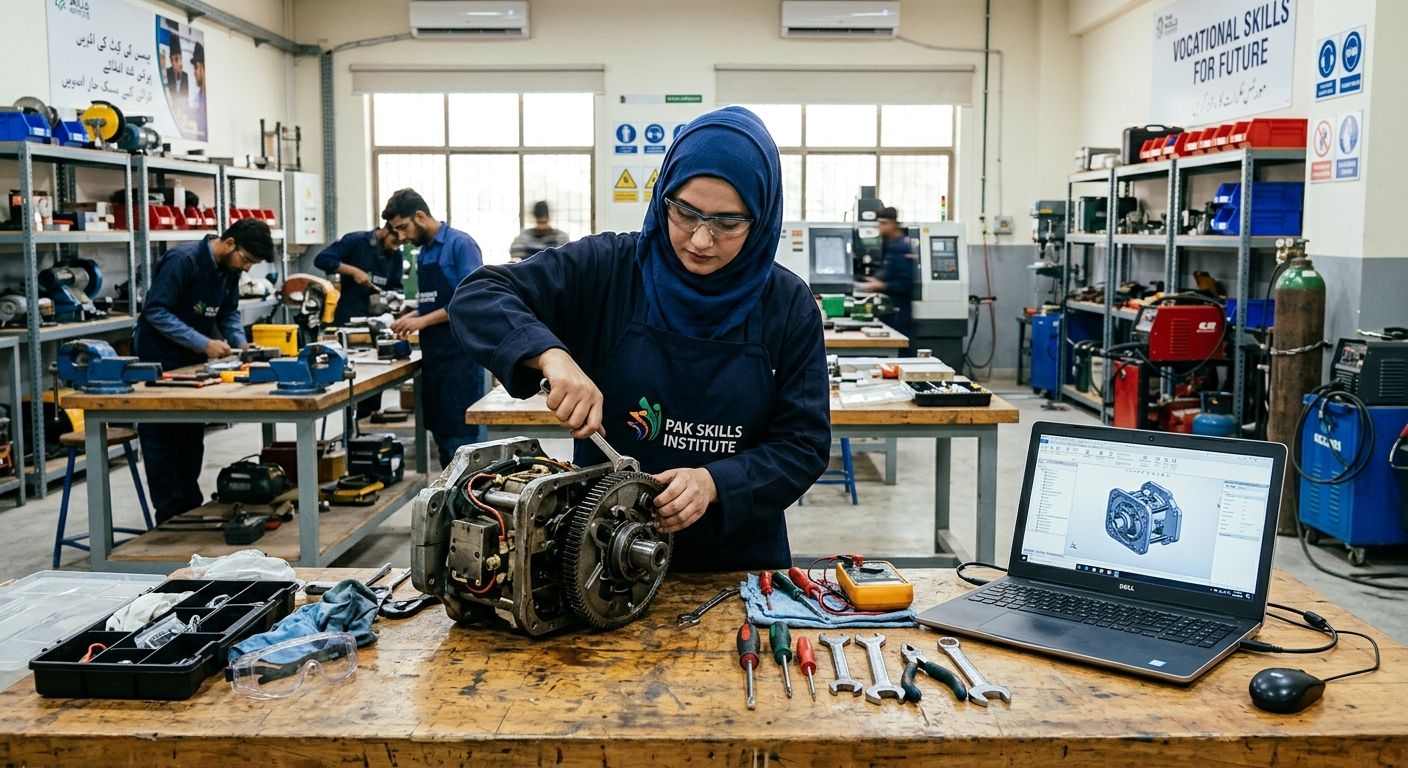
The term used to mean only workshop trades like welding or carpentry. That has changed. Today it covers two kinds of work:
- Hands-on trades. Electrical work, plumbing, HVAC, welding and lineworker jobs. You need tools, a site and usually a license.
- Digital vocational skills. AI automation, digital marketing, UI/UX design, cybersecurity support and video editing. You need a laptop, practice and a portfolio.
Both share the same promise. A client or employer pays for what you can do, not for the degree on your wall.
Attitudes are shifting too. In Jobber's Blue Collar Report, reported by Forbes, more Gen Z respondents said college is no longer the surest path to a solid career than said it still is (42% to 36%). And 76% said it is important to choose a career that is hard to automate.
Vocational skills that pay well: side-by-side comparison
Use this table to compare pay and training time at a glance.
- Trade pay and training come from the US Bureau of Labor Statistics (median annual wage, May 2025).
- Digital pay is the typical freelance hourly rate on Upwork (May 2026).
- Digital training times and the AI-risk column are WeVersity's own estimates, not measured data.
Skill
Typical pay
Time to job-ready
Where you learn
AI risk (our estimate)
Elevator and escalator installer
$109,910 / year
4-year paid apprenticeship
Hands-on
Low
Electrical power-line installer
$95,320 / year
Up to 3-year apprenticeship
Hands-on
Low
Wind turbine technician
$64,120 / year
Certificate + employer training
Hands-on
Low
Plumber / pipefitter
$63,800 / year
4–5-year paid apprenticeship
Hands-on
Low
Electrician
$63,190 / year
4–5-year paid apprenticeship
Hands-on
Low
HVAC technician
$61,010 / year
Certificate + on-the-job training
Hands-on
Low
Welder
$53,750 / year
On-the-job or technical training
Hands-on
Medium
Penetration tester (cybersecurity)
$60–120 / hour
12+ months (est.)
Online + labs
Low–Medium
AI developer / automation
$30–50 / hour
3–6 months (est.)
Online
Medium
Digital marketer
$15–45 / hour
3–6 months (est.)
Online
Medium
UI/UX designer
$20–40 / hour
6–9 months (est.)
Online
Medium
Video editor
$10–60 / hour
3–6 months (est.)
Online
Medium
Content writer
$15–40 / hour
1–3 months (est.)
Online
High
Our AI-risk rating is a judgment call based on how much of each job today's AI tools can already do. No official source measures this, so treat it as guidance, not fact.
Hands-on trades that still pay well
These trades pay well because the work is physical, often licensed and hard to outsource. Most start with a high school diploma, and many pay you while you train. You can start building hands-on skills online too: WeVersity has beginner courses in carpentry and woodworking, tiling and flooring, and motorcycle repair (in Urdu).
1. Elevator and escalator installer
This is the best-paid trade on this list, well above the $50,980 median for all US jobs. You learn through a 4-year paid apprenticeship. The work mixes electrical, mechanical and safety skills in tight, high spaces. There are only about 1,900 openings a year, so places are competitive.
2. Electrical power-line installer
Lineworkers build and repair the grid. BLS expects 10% job growth from 2025 to 2035, driven by rising electricity demand, new construction and AI data centers. The job involves high voltage and heights, and that risk is part of why it pays well.
3. Wind turbine technician
This is the fastest-growing trade on this list, with 30% projected growth from 2025 to 2035. You usually need a technical certificate, then on-the-job training from the employer. Expect travel and climbing.
4. Plumber and pipefitter
You learn through a 4–5-year apprenticeship with about 2,000 paid hours of on-the-job training a year. BLS projects around 42,000 openings every year. Many plumbers later start their own business, which is where income can grow past the median.
5. Electrician
There are about 821,000 electrician jobs in the US, with around 72,700 openings a year. BLS links growth to solar and wind power, grid upgrades and AI data centers. Like plumbing, this trade leads naturally to running your own contracting business.
6. HVAC technician
Heating and cooling techs usually complete a certificate program, then train on the job. Most also need EPA certification to handle refrigerants. BLS projects 11% growth from 2025 to 2035, with about 40,600 openings a year.
7. Welder
Welding is quick to enter and in demand in many countries. BLS projects only 2% growth, but about 40,300 openings a year, mostly to replace workers who retire or change jobs. Specialist certificates, such as pipe welding, can open better-paid work than general factory jobs.
Digital vocational skills that pay well
Digital skills are vocational skills too. You learn them by doing real projects, and clients pay for results, not degrees. The big difference from trades is access: you can learn from home, start in months, and sell your work to clients in any country.

On Upwork, beginners usually charge $10–25 an hour. Freelancers with solid experience and proven results charge $25,60, and experts with deep specialisation charge $60–120 or more (Upwork, May 2026). Your rate rises with your portfolio and reviews.
1. AI automation
Businesses pay people to connect AI tools to their daily work. That could be a chatbot for customer questions or an automation that sends invoices. Tools like Zapier, Make and n8n let you build this without being a full programmer. To start, try WeVersity's n8n automation course or learn to build WhatsApp automations for local businesses.
2. Cybersecurity
Penetration testers legally hack systems to find weak spots, and on Upwork they typically charge $60–120 an hour. The skill takes longer to learn, usually a year or more of labs and practice. Certificates such as CompTIA Security+ help clients trust you. If you already code, WeVersity's Cybersecurity for Developers course is a practical first step.
3. UI/UX design
UI/UX designers plan how apps and websites look and work. You need Figma, an eye for detail and a portfolio of 3–5 real case studies. Start by creating your first UI screen in Figma, then practise with real audits and learn to sell design templates.
4. Digital marketing and SEO
Every business wants more customers online. Marketers who can show real numbers, such as leads, sales or rankings, can charge more. Paid ads (Google, Meta) and SEO are common specialties. WeVersity offers hands-on training in SEO and social media marketing, plus prep for the Google Ads Search certification.
5. Video editing
Short-form video is a big part of social media, and editors who understand hooks, pacing and captions are in demand. The pay range is wide ($10–60 an hour on Upwork), because an editor who grows a client's channel can charge far more than one who only cuts clips. Beginners can start with WeVersity's CapCut Mastery or Video Editing for Social Media Creators.
WeVersity tip: Your first client is paying for proof, not promises. Before you pitch, finish one small project from start to finish and show the before and after. One complete, real example beats ten unfinished practice files.
Which vocational skills can AI not replace?
In our view, the safest skills need at least one of three things AI does not have: hands, judgment on the spot, or a client's trust.
- Hands on real equipment. No AI can crawl into a ceiling to fix wiring or climb a wind turbine. That is why we rate the hands-on trades as the lowest risk.
- Judgment under pressure. A cybersecurity analyst deciding whether an attack is real, or a lineworker checking a live line, makes calls that carry real consequences.
- Client trust. Clients pay a designer or marketer they trust to understand their business. AI can speed up the work, but someone still has to own the result.
The riskiest work is anything AI can produce alone in seconds, such as basic copywriting, simple logo design or data entry. The fix is not to avoid these fields. Learn to use AI tools inside them, and sell your judgment on top. Our AI skills roadmap for 2026 shows which tools to learn first.
A simple test: if a client could get your work by typing one prompt, your skill needs an upgrade.
From skill to income in 90 days (digital skills)
Most courses stop at a certificate. Clients do not hire certificates; they hire proof. This is the path WeVersity coaches use with beginners.
- Days 1–30: Learn one narrow skill. Pick one service, not a whole field. For example, "Canva social posts for restaurants" beats "graphic design". Practise daily with a mentor who reviews your work.
- Days 31–60: Build three portfolio pieces. Do real or realistic projects: redesign a local shop's page, or automate a friend's booking form. Show the before, the after, and the result.
- Days 61–75: Set up where clients look. Create a Fiverr or Upwork profile, a LinkedIn profile and a one-page portfolio. Price low at first to win reviews.
- Days 76–90: Pitch every day. Send a few tailored proposals every day. Expect plenty of rejections at first. Persistence is what separates people who land clients from people who quit.
Be realistic. Some learners land their first paid project inside 90 days; for others it takes six months or more. What they have in common is daily practice and feedback.
If you're in Pakistan or aiming for the Gulf
A certified skill can raise your income, at home or abroad. More than 700,000 Pakistanis have left for overseas jobs in recent years, most of them bound for Gulf countries, and roughly half are classed as unskilled or semi-skilled (Arab News, May 2026). The same report says a skilled worker in the GCC typically earns two to four times what an unskilled worker does.
It also notes that Gulf giga-projects need well over a million skilled workers. Meanwhile, countries like India, the Philippines and Bangladesh have invested heavily in certification and overseas job training, and some Pakistani technical diplomas are not recognised by Gulf contractors.
What to do about it:
- For trades, train at a NAVTTC- or TEVTA-registered institute. Before applying for Saudi jobs, check whether your trade needs the Saudi Skill Verification Program test.
- For digital skills, you do not need to move. Freelancers in Pakistan sell AI, design, marketing and development services to clients abroad and are paid in dollars. Our complete guide to freelancing in Pakistan explains how to start and get paid.
- In both cases, get a certificate that employers or clients outside Pakistan recognise, and keep proof of real projects. For digital work, Google's advertising and analytics certifications are a strong start.
How to choose the right vocational skill
The best skill is the one you will still be practising in six months. Answer these five questions honestly before you pick.
- Do you prefer working with your hands or on a screen? If you like tools and moving around, choose a trade. If you like solving problems at a desk, choose a digital skill.
- How soon do you need income? Apprenticeships pay while you learn, but take years to reach full pay. Digital skills can start earning within months, but income is uneven at first.
- Can you move for work? Trades are tied to where the job site is. Digital work goes wherever your internet does.
- What can you afford to start? Apprenticeships are usually paid. Digital skills need a laptop, a stable connection and a course.
- Who will teach you? A mentor who already earns with the skill saves you months of guessing. Look for real feedback on your work, not just recorded videos.
Still unsure? Try a beginner lesson in two skills for one week each, and keep the one you enjoyed.
Start learning a skill that pays
WeVersity connects you with coaches who teach practical skills, including AI, cybersecurity, UI/UX and digital marketing. You get live feedback, real projects and a clear path to your first client. Browse WeVersity courses and pick one skill to start this week.