

Quick Answer
Local SEO helps your business appear when nearby people search on Google Maps, in the local pack, and in AI-powered search experiences. Google says local results depend mainly on relevance, distance, and prominence. You can improve relevance and prominence with an accurate Google Business Profile, genuine reviews, a useful website, and consistent business listings. You cannot directly control distance.
People search for terms like “plumber near me” when they need help quickly. Many local SEO guides repeat the same checklist. This guide explains how local rankings work, which improvements matter, how AI search affects visibility, and which shortcuts can put your business profile at risk. If you are new to search, start with our guide on how search engines actually rank websites.
How Google Decides Who Appears in “Near Me” Results
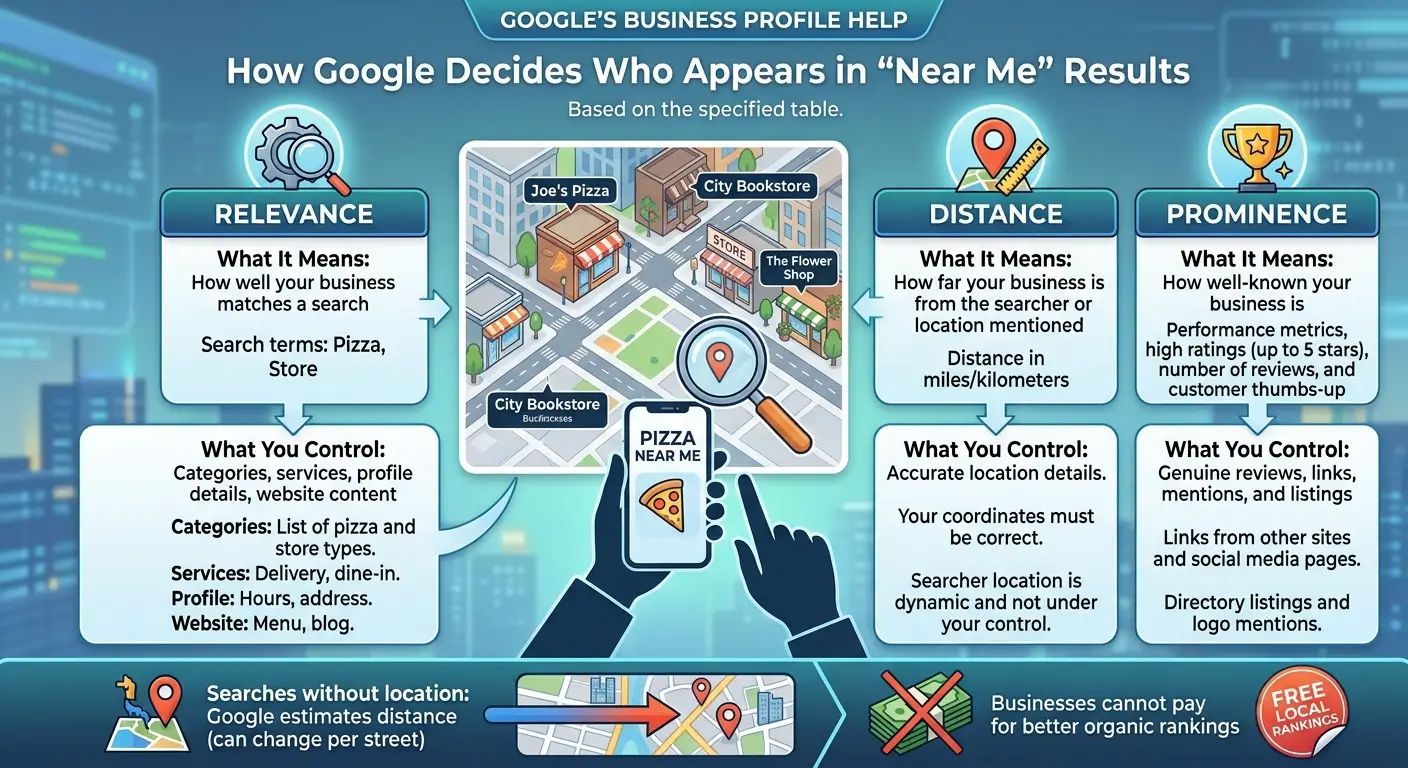
Google's Business Profile Help documentation identifies three main factors behind local results.
Factor
What It Means
What You Control
Relevance
How well your business matches a search
Categories, services, profile details, website content
Distance
How far your business is from the searcher or the location mentioned
Accurate location details, but not the searcher's distance
Prominence
How well-known your business is
Genuine reviews, links, mentions, and listings
When someone searches without naming a location, Google estimates distance using the searcher's location. Results can therefore change from one street to another. Google also states that businesses cannot pay for better organic local rankings.
Which Local SEO Signals Matter Most?
Whitespark's 2026 Local Search Ranking Factors report surveys local SEO experts on what drives local pack and Maps rankings. Three findings stand out:
- Primary Google Business Profile category ranks as the number one individual factor for local pack and Maps results.
- Review signals and behavioral signals (such as clicks and calls) gained importance compared with previous years.
- Citations lost a little weight, about half a percentage point.
The report groups signals into categories and estimates how much each one contributes:
Signal Group
Estimated Weight
Google Business Profile
32%
Reviews
20%
Website content
15%
Clicks, calls, and other behavior
9%
Links
8%
Citations
6%
Personalization
6%
Social
4%
These figures represent practitioner estimates, not Google's official ranking formula. Use them to prioritize your work rather than treat them as guaranteed ranking weights.
Build a Google Business Profile That Earns Trust
A strong foundation for local SEO is a complete, accurate, and eligible Google Business Profile. Google recommends verifying your business and keeping its details up to date. For a field-by-field walkthrough, see Whitespark's Google Business Profile optimization guide.
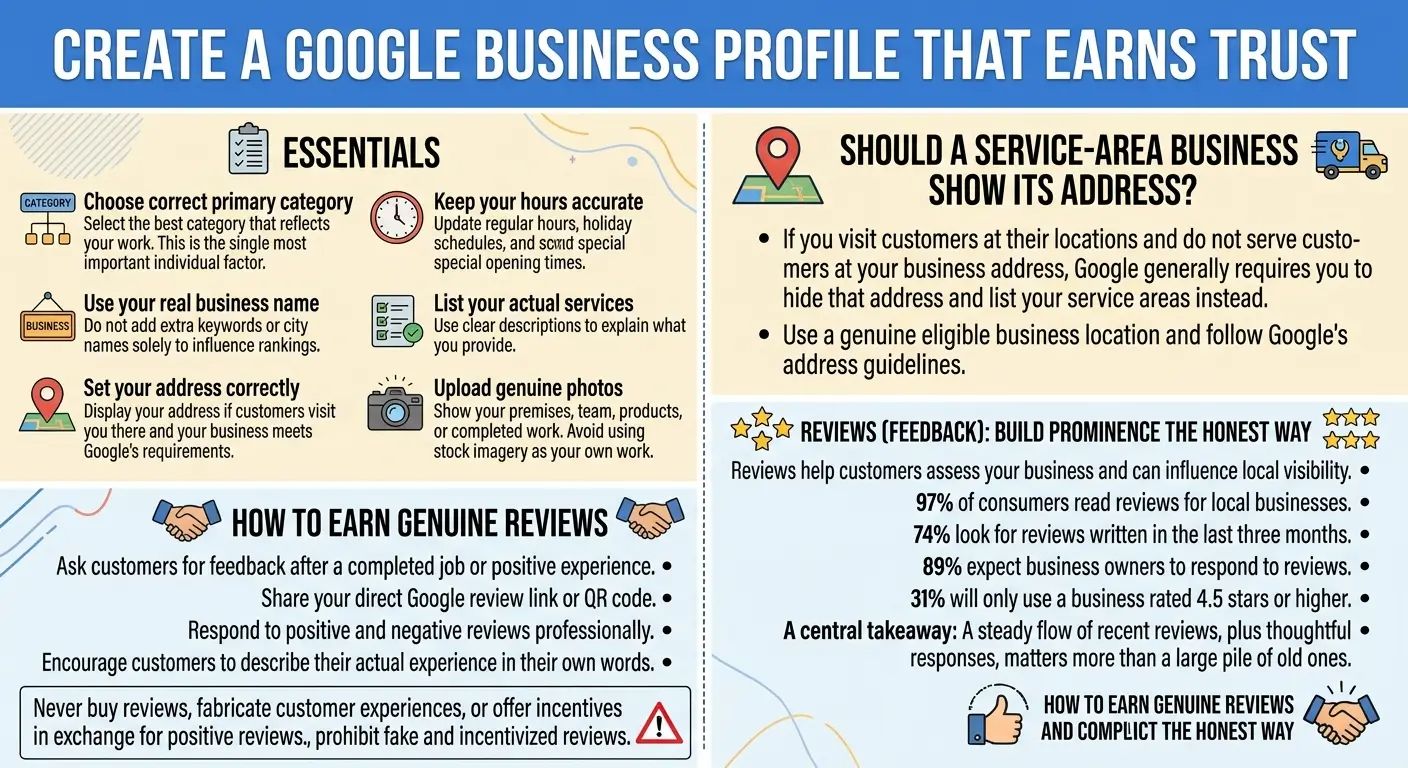
- Choose the right primary category. Select the most specific category that accurately describes your main business. This is the single most important individual factor in Whitespark's survey.
- Use your real business name. Do not add extra keywords or city names solely to influence rankings. See Google's guidelines for representing your business.
- Set your address correctly. Display your business address if customers visit you there and your business meets Google's requirements.
- Keep your hours accurate. Update regular hours, holiday schedules, and special opening times.
- List your actual services. Use clear descriptions that explain what you provide.
- Upload genuine photos. Show your premises, team, products, or completed work. Avoid presenting stock imagery as your own work.
Should a Service-Area Business Show Its Address?
If you visit customers at their locations and do not serve customers at your business address, Google generally requires you to hide that address and list your service areas instead. Use a genuine eligible business location and follow Google's address guidelines.
Reviews: Build Prominence the Honest Way
Reviews help customers assess your business and can influence local visibility. BrightLocal's 2026 Local Consumer Review Survey of 1,002 US adults found that:
- 97% of consumers read reviews for local businesses.
- 74% look for reviews written in the last three months.
- 89% expect business owners to respond to reviews.
- 31% will only use a business rated 4.5 stars or higher, up from 17% in 2025.
The lesson is simple: a steady flow of recent reviews, plus thoughtful responses, matters more than a large pile of old ones. There is no official review count that guarantees a higher ranking, so compare yourself with relevant competitors in your area.
How to Earn Genuine Reviews
- Ask customers for feedback after a completed job or positive experience.
- Share your direct Google review link or QR code.
- Respond to positive and negative reviews professionally.
- Encourage customers to describe their actual experience in their own words.
Never buy reviews, fabricate customer experiences, or offer incentives in exchange for positive reviews. Google's policies prohibit fake and incentivized reviews. The US Federal Trade Commission's 2024 rule also restricts fake reviews and certain review-related practices in the United States.
Make Your Website Prove You Serve the Area
Your website can help customers and search engines understand your services and the locations you serve.
- Create useful service pages. Explain each core service with accurate details, photos, pricing context, and examples of your work.
- Create meaningful location pages. Build separate pages for locations where you genuinely operate when each page provides distinct value.
- Keep business details consistent. Use the correct business name, address where appropriate, and phone number on your website.
- Write natural page titles. Include a service and location where relevant without repeating keywords unnaturally. Our session on keyword research for local SEO shows how to find the right terms.
- Add LocalBusiness structured data. Use appropriate LocalBusiness structured data to help search engines interpret your business information.
- Show firsthand experience. Include real project examples, local knowledge, original photos, and useful answers to customer questions.
- Make your website mobile-friendly. Use tappable phone numbers, readable, accessible design, and fast-loading pages.
To strengthen the website side of your strategy, read our guide on getting your website to rank on Google. If you want to build the site yourself, our website development course covers the basics.
Citations: Keep Your Business Details Consistent Everywhere
A local citation is an online mention of your business details, commonly its name, address, and phone number (NAP). Consistency helps customers identify the correct business and can support trust across local listings.
Where to List Your Business
Why It Matters
Google Business Profile
Google Maps and local search visibility
Apple Business Connect / Apple Maps
Apple Maps and related Apple services
Bing Maps and Bing search visibility
Facebook (learn social media marketing)
Business discovery and customer reviews
Industry directories
Relevant industry and local references
Local chambers of commerce
Local business recognition and potential links
Quick audit: Search your business name and phone number online. Correct outdated details and investigate duplicate listings.
Links and Mentions That Raise Prominence
Google can use information from across the web to understand how prominent a business is. Focus on legitimate ways to build local recognition.
- Sponsor a local event or community initiative and seek an appropriate mention.
- Join a relevant chamber of commerce or trade association.
- Provide expert commentary to local news outlets.
- Collaborate with nearby businesses that serve similar customers.
- Ask suppliers to include your business in relevant partner directories.
Avoid buying links intended to manipulate rankings, which Google's spam policies prohibit. Focus on genuine relationships and useful references.
Local SEO for Small Business in the Age of AI Overviews and Chatbots
AI-powered search experiences are changing how people discover local businesses. However, the fundamentals of useful content, accurate business information, and search accessibility remain important.
What Should Small Businesses Do?
- Keep your Google Business Profile complete and accurate.
- Earn genuine reviews that describe actual services and customer experiences.
- Maintain accurate listings on relevant platforms, including Bing and Apple Maps.
- Ensure search engines can crawl important pages on your website.
- Answer practical questions about pricing, hours, service areas, and booking.
- Earn relevant mentions from trusted local organizations and websites.
To go further, explore our course on AI marketing and customer finding for local businesses.
Does llms.txt Help Local Businesses Appear in AI Answers?
There is currently no established evidence that adding an llms.txt file improves local rankings or guarantees citations in AI-generated answers. An SE Ranking analysis of 300,000 domains found no clear effect on AI citations. Do not treat it as a replacement for useful content, accurate listings, or sound technical SEO.
Mistakes That Cost Visibility or Trigger Suspension
Avoid these common local SEO issues:
- Adding keywords to your business name solely to influence rankings. (Whitespark's 2026 study explores how this affects rankings.)
- Using a P.O. box or ineligible virtual office as a business location.
- Displaying a home address when it should be hidden for a service-area business.
- Listing service areas that do not reflect where you actually operate.
- Creating duplicate profiles for the same business location.
- Uploading photos that falsely represent your business or work.
- Allowing incorrect business details to remain across directories.
- Buying, fabricating, or improperly incentivizing reviews.
- Publishing large numbers of near-identical location pages with little useful content.
Example: Applying Local SEO to a Home Bakery
This is an illustrative scenario showing how the steps fit together, not a client case study.
Imagine Sana runs a custom cake business from her home in Lahore, one of the popular home-based business ideas in Pakistan. Customers order online and either collect from her gate or get home delivery across three nearby areas.
Problem
What She Changes
Why It Helps
Profile category set to “Restaurant”
Changes primary category to “Cake shop”
Improves relevance for “custom cake near me” searches
Business name listed as “Sana's Best Cakes Lahore Cheap Bakery”
Uses her real brand name, “Sana's Cakes”
Follows Google's guidelines and reduces suspension risk
Home address visible, although customers mainly receive deliveries
Reviews Google's address rules, hides the address if pickup is not offered, and lists only her three delivery areas
Keeps the profile eligible and accurate
Only five reviews, all over a year old
Adds a review QR code to every cake box and replies to each review within two days
Builds the recent reviews that 74% of consumers look for
Instagram is her only website
Creates one simple page with her menu, price ranges, delivery areas, and order steps
Gives Google and AI tools clear information to cite
Different phone numbers on Facebook and Google
Uses one number everywhere
Removes confusing, conflicting business details
Sana then follows the four-week plan below and checks her Google Business Profile Performance data each month. If you are starting a food business like hers, our Profitable Home Chef course covers the business side. The same approach works for a plumber, tutor, salon, or repair shop: fix the category and details first, then build recent reviews and a useful page.
A Four-Week Local SEO Plan You Can Start Today
Week
Focus
Tasks
1
Foundation
Verify your profile, correct your category and details, add services and genuine photos
2
Consistency
Audit business details, claim relevant listings, investigate duplicates
3
Reviews and website
Request genuine reviews, respond to feedback, improve service pages, add suitable structured data
4
Prominence and tracking
Pursue two legitimate local mentions or link opportunities and record baseline performance
Short on time? Our course on AI for small business owners shows how to speed up routine tasks such as drafting review replies and service descriptions.
How to Measure Local Search Results
Use a combination of analytics tools and manual checks to understand whether your improvements are working.
- Google Business Profile Performance: Review available searches, calls, direction requests, and website clicks.
- Google Search Console: Monitor impressions, clicks, and queries related to your services and locations.
- Bing Webmaster Tools: Review available search performance and the AI Performance report.
- Manual checks: Compare results from different locations and devices, remembering that results vary by searcher and context.
To track website visitors from local search in more depth, prepare for the Google Analytics Certification.
Final Thoughts
Local SEO for small businesses works best as an ongoing process, not a one-time project. Start by correcting your Google Business Profile, earning genuine customer reviews, keeping business details consistent, and publishing helpful website pages.
Track your performance each month, learn from your competitors, and improve the areas that matter most to your customers. Start with the first week's tasks today. If you want step-by-step guidance, join WeVersity's Local SEO Master Course or build a broader foundation with SEO from Zero to Google Ranking.